
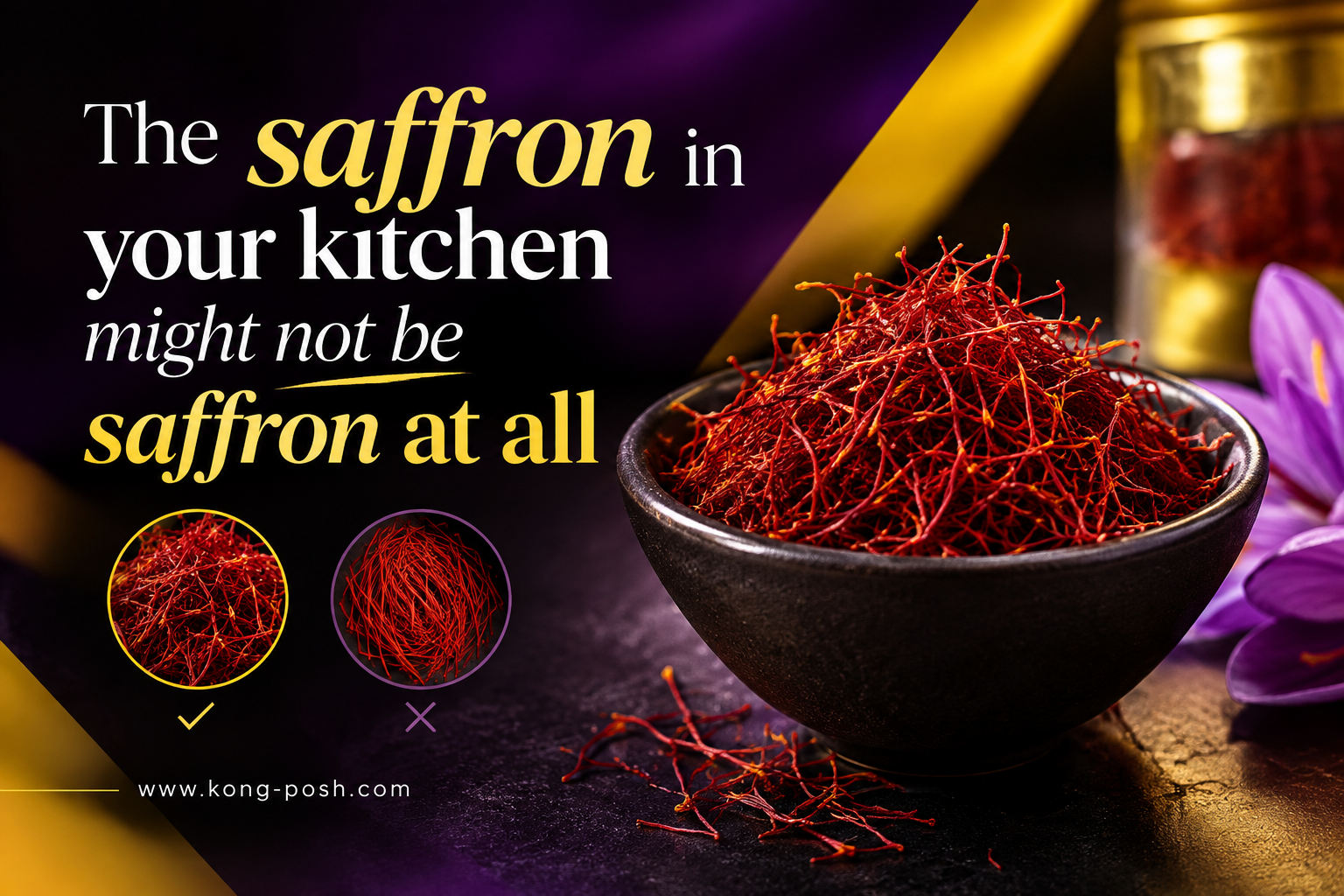
The saffron adulteration crisis is closer than you think
Saffron has always carried a reputation for rarity, craftsmanship and exceptional value. But that value has also created a serious problem for consumers: not everything sold as saffron is necessarily pure saffron.
A jar may look convincing. The threads may be beautifully red. The packaging may appear premium. The seller may even describe the product as “pure,” “premium,” “natural” or “Kashmiri.” But attractive packaging is not proof of authenticity.
For anyone buying saffron today, the real question is not simply, “Where can I buy saffron?” The better question is, “How can I tell whether this saffron is actually genuine?”
That distinction matters because adulteration can involve adding other plant materials, artificial colouring, exhausted saffron, low-quality material or other substances intended to imitate the appearance, weight or colour of genuine saffron. Some forms of adulteration can be difficult to identify without proper laboratory testing.
This is why consumers need to become more informed before buying.
At Saffron Cottage, our philosophy is simple: saffron should be respected from the field to the kitchen. We are the growers of FINEST KASHMIRI SAFFRON harvesting from 7th generations, and we believe customers should understand what they are purchasing rather than simply trusting a label.
Why is saffron so often targeted for adulteration?
Saffron is one of the world’s most valuable spices by weight, and genuine saffron requires significant labour to cultivate, harvest and process.
The red stigmas of the Crocus sativus flower are collected carefully, generally by hand. Thousands of flowers are required to produce relatively small quantities of finished saffron.
That combination of high value, low volume and strong consumer demand creates an incentive for dishonest sellers to make cheaper material look like the real thing.
The problem becomes even more complicated online.
A consumer can no longer necessarily see, smell or handle the saffron before purchasing it. A product photograph can show bright red threads, while a marketplace description can promise premium quality. Neither one independently establishes authenticity.
This is where consumer education becomes powerful.
The more buyers understand saffron’s physical characteristics, origin, processing and quality indicators, the harder it becomes to sell questionable material simply because it looks convincing.
What does real saffron actually look like?
One of the first things consumers should understand is that genuine saffron does not need to look artificially perfect.
Saffron consists of the dried stigmas of the Crocus sativus flower. Good-quality threads can show natural variation in shape, length and appearance.
Pure saffron is generally deep red to crimson rather than an unnaturally uniform fluorescent red. Depending on processing and quality, individual threads may have slightly different tones and shapes.
This is important because counterfeit products may be designed to create an immediate visual impression.
A buyer sees intensely coloured strands and assumes that stronger colour means better saffron.
That assumption can be misleading.
Colour intensity alone cannot prove authenticity.
A more informed evaluation considers appearance together with aroma, infusion behaviour, provenance, packaging, traceability and, where necessary, laboratory analysis.
1. Extremely uniform threads can deserve a closer look
Real agricultural products naturally have variation.
If every thread in a packet appears almost identical in length, shape, thickness and colour, it is reasonable to examine the product more carefully.
That does not automatically mean the saffron is fake. Processing and sorting can create consistency. But excessive uniformity combined with other warning signs should encourage a buyer to investigate further.
Authentic saffron should ultimately be evaluated as a botanical product, not simply as a beautifully packaged red spice.
Look closely.
Are the threads naturally shaped?
Do they have the characteristic saffron stigma form?
Are there suspiciously similar pieces that appear manufactured?
Are there unusually large amounts of powder or broken material?
These questions can help you become a more careful buyer.
2. Watch what happens when saffron meets water
One of the most commonly discussed home checks is the water test.
Place a few saffron threads into warm water and observe the infusion.
Genuine saffron gradually releases its colour into the liquid. The threads themselves should not simply behave like brightly dyed fibres.
However, this test needs an important warning.
A water test is not a laboratory authentication method.
Different genuine saffron grades and processing conditions can produce different infusion characteristics. At the same time, some adulterants may also release colour.
Therefore, if someone tells you that a single water test can prove saffron is genuine with absolute certainty, be cautious.
Use home observations as warning signs, not as definitive scientific certification.
3. Artificially intense colour should raise questions
Saffron is valued partly because its colouring compounds, especially crocins, naturally contribute to its characteristic colour.
But a buyer should not assume that the brightest red product is automatically the best.
If saffron appears unnaturally bright, especially when combined with bleeding colour, suspiciously uniform threads or a chemical-like appearance, investigate further.
A trustworthy seller should be able to explain where the saffron comes from, how it is harvested and how its quality is maintained.
Transparency is much more valuable than exaggerated claims.
4. Aroma matters more than many buyers realize
Authentic saffron has a distinctive aroma.
It is difficult to describe with one simple word because saffron’s aroma comes from a complex mixture of volatile compounds. Many people perceive genuine saffron as earthy, hay-like, honeyed, floral or slightly medicinal.
What you should not expect is an overwhelmingly artificial perfume.
Open the package and pay attention.
Does the saffron have a natural, distinctive fragrance?
Does it smell strangely chemical?
Is there almost no aroma at all?
A weak or unusual smell does not independently prove adulteration, but when several warning signs appear together, it is worth reconsidering the purchase.
5. Taste should not be the only test
Some people recommend tasting saffron to determine authenticity.
But taste alone is unreliable.
Genuine saffron has a distinctive bitter, earthy character, but consumers should not attempt to identify a product solely through taste. Adulterated materials can also have strong flavours, while individual perceptions vary.
More importantly, consuming an unknown substance simply to test whether it is genuine is unnecessary.
A better approach is to purchase from a transparent supplier with clear sourcing and quality information.
6. The price may tell you something, but not everything
Here is where consumers need to think carefully.
Very cheap saffron should trigger questions.
That does not mean every expensive saffron product is genuine, and it certainly does not mean that price alone proves quality.
But genuine saffron is labour-intensive, and its production economics are fundamentally different from inexpensive coloured plant material.
When a seller offers a product at a dramatically lower price than comparable genuine saffron while making premium-quality claims, ask how that price is possible.
Is the product pure?
What is the origin?
What grade is being sold?
How is it processed?
Is the seller able to provide traceability?
Is the weight accurate?
Is it actually saffron, or a mixture?
The right question is not “Why is saffron expensive?”
The better question is “What am I actually paying for?”
7. Powder can make authenticity harder to evaluate
Saffron powder is convenient, but whole threads offer consumers an important advantage: visibility.
When saffron is sold as whole threads, buyers can inspect the physical material.
Once a product is heavily powdered, visual identification becomes much more difficult.
That does not mean all saffron powder is adulterated. Genuine saffron powder exists and can be useful in cooking.
But if authenticity is your priority, whole saffron threads from a traceable source can make it easier to evaluate what you are purchasing.
For premium buyers, this distinction matters.
You are not simply buying colour.
You are buying a botanical product with a specific origin, production process and quality profile.
8. Packaging cannot replace traceability
Premium packaging can make a product look trustworthy.
But a beautiful box does not establish authenticity.
Before buying saffron, look beyond the design.
Ask where it was grown.
Ask who harvested or supplied it.
Look for batch information where applicable.
Check whether the seller clearly identifies the product’s origin.
Look for a legitimate business presence and transparent contact information.
Find out whether the seller can explain its sourcing rather than relying entirely on generic phrases such as “100% pure,” “best saffron” or “premium quality.”
Trust should come from evidence and transparency, not packaging alone.
9. “Kashmiri saffron” should mean more than a marketing phrase
The word “Kashmiri” carries enormous recognition in the saffron market.
But consumers should not automatically assume that anything labelled Kashmiri was necessarily cultivated in Kashmir.
Origin matters.
A serious saffron buyer should ask questions about geographical sourcing and traceability rather than treating a regional name as a decorative marketing term.
For Saffron Cottage, Kashmiri saffron is connected to agricultural heritage, cultivation and generations of knowledge.
Our brand story is built around being growers of FINEST KASHMIRI SAFFRON harvesting from 7th generations.
That heritage is important to us because saffron should not be reduced to a commodity whose only selling point is a red colour and a premium-looking box.
What are the biggest mistakes people make when buying saffron?
One of the biggest mistakes is buying based exclusively on price.
Another is trusting the product photograph.
Another is assuming that the words “pure,” “organic,” “premium” or “Kashmiri” automatically prove authenticity.
Another is believing that one viral home test can scientifically authenticate saffron.
And perhaps the biggest mistake is failing to ask questions.
Consumers have every right to ask a saffron seller about origin, quality, packaging, sourcing and product characteristics.
A genuine seller should understand why those questions matter.
Can home tests prove that saffron is genuine?
This is an important question because misinformation about saffron testing spreads quickly online.
Home checks can help identify suspicious characteristics, but they should not be treated as definitive authentication methods.
Water behaviour, aroma, appearance and taste can provide useful observations. However, scientific authentication may require analytical techniques capable of evaluating saffron’s chemical composition and detecting adulteration.
For buyers making significant purchases, professional testing and credible certification can provide stronger evidence than internet “hacks.”
The lesson is simple: use home tests as clues, not certificates.
What should you ask before buying saffron online?
Before placing an order, ask the seller several straightforward questions.
Where was the saffron grown?
Is it whole-thread saffron?
What is the stated grade?
How is the saffron harvested and processed?
How is the product packaged?
Can the seller explain its supply chain?
Does the seller provide batch or traceability information where appropriate?
What is the business’s return or customer-support policy?
Can the seller explain how it maintains quality?
The answers can reveal a great deal about the seriousness of the supplier.
A seller that avoids basic questions should make you pause.
A seller that welcomes informed questions is giving you an opportunity to understand the product before purchasing.
Why buying directly from growers can change the conversation
The closer you can get to the source, the more meaningful the conversation around authenticity can become.
Growers understand that saffron is not produced inside a factory. It begins with cultivation, flowering, harvesting and careful post-harvest handling.
For a brand such as Saffron Cottage, the story is therefore not simply about selling a spice.
It is about connecting customers with the agricultural heritage behind the product.
We are the growers of FINEST KASHMIRI SAFFRON harvesting from 7th generations.
That statement represents the foundation of our brand identity and our commitment to bringing Kashmiri saffron to customers who care about what they put into their kitchens.
The future of saffron buying is moving toward transparency
Consumers are becoming more interested in where their food comes from.
That trend extends beyond saffron.
People increasingly want traceability, responsible sourcing, product information and evidence behind premium claims.
Digital commerce is making this even more important.
When customers cannot physically inspect a product before purchasing it, brands need to communicate more clearly.
Product pages need useful information rather than exaggerated promises.
Packaging needs traceability.
Businesses need to answer questions.
And customers need to become more informed.
The future of premium saffron will not be built solely on attractive packaging. It will increasingly depend on trust.
A simple saffron buyer’s checklist
Before purchasing saffron, slow down and examine the complete picture.
Look at the threads.
Smell the product.
Consider how it behaves during infusion.
Question unusually low prices.
Check the stated origin.
Look for traceability.
Understand whether you are buying whole threads or powder.
Research the seller.
Ask questions before paying.
And remember that no single visual or home test can guarantee authenticity.
If the seller cannot explain what you are buying, why should you feel comfortable putting it into your kitchen?
Don’t let fake saffron become an expensive lesson
Saffron is too valuable to buy blindly.
The biggest protection against adulteration is not fear. It is knowledge.
Learn what genuine saffron looks like. Understand its origin. Ask questions. Examine the product. Research the supplier. And choose businesses that are willing to be transparent about what they sell.
At Saffron Cottage, our relationship with Kashmiri saffron is rooted in generations of cultivation and knowledge.
We are the growers of FINEST KASHMIRI SAFFRON harvesting from 7th generations.
If you are looking for Grade A Premium Kashmiri Saffron, take the time to understand the product before you buy. Your kitchen deserves more than a convincing label. It deserves saffron you can purchase with confidence.
Discover the difference between buying saffron because it looks premium and buying saffron because you understand where it comes from.
Explore Saffron Cottage and discover our Kashmiri saffron: www.kong-posh.com