
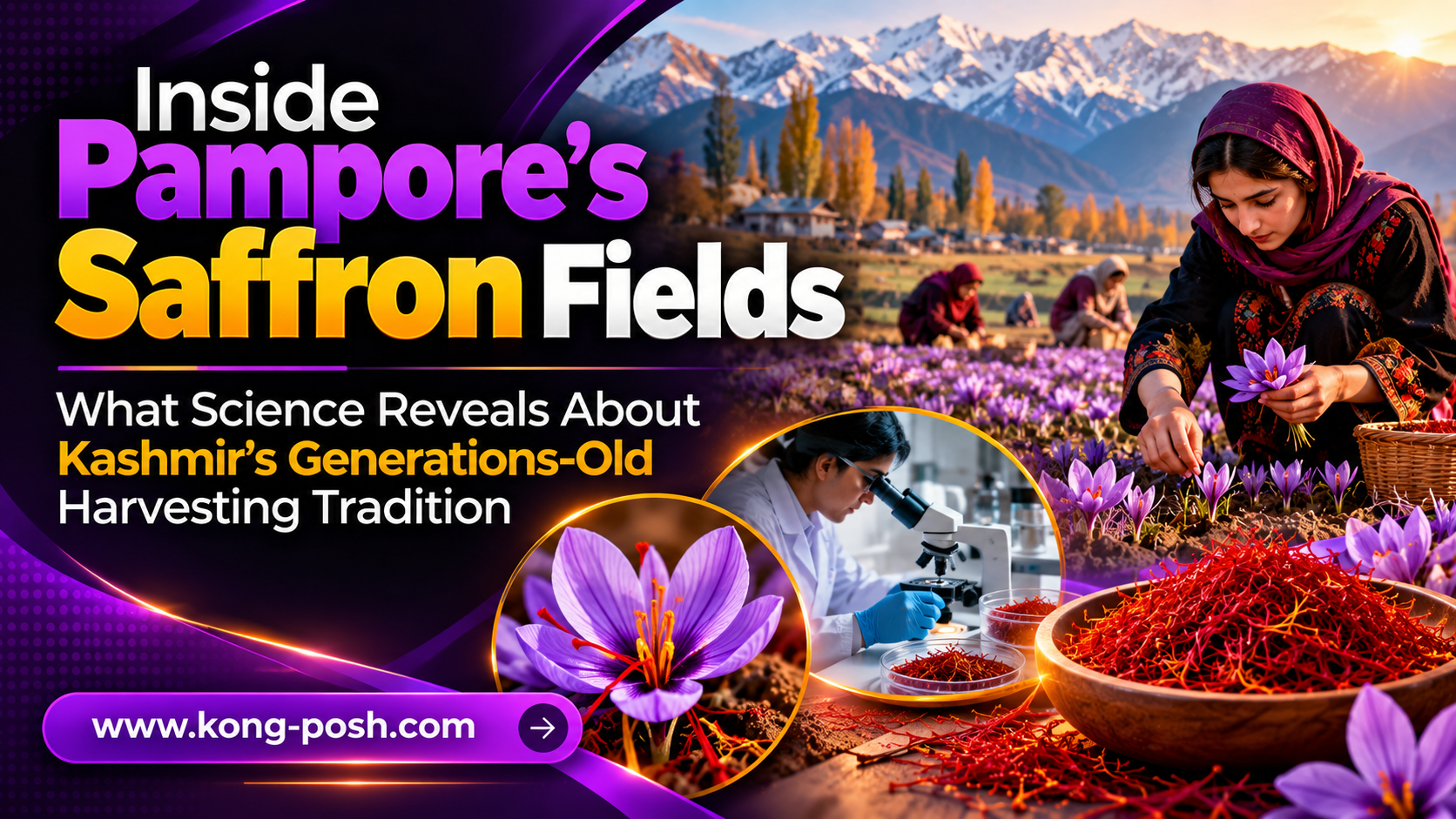
1. Pampore’s Saffron Heritage: Where Every Flower Tells a Story
In Pampore, Kashmir, saffron is more than a valuable spice. It is a seasonal harvest shaped by the land, the weather, skilled hands and generations of agricultural knowledge. When the purple crocus flowers appear in autumn, growers enter one of the most delicate periods of the farming calendar. Each flower contains three red stigmas, the precious threads that become saffron after careful separation and drying. Producing a small quantity of finished spice requires considerable manual work, precision and patience. For Saffron Cottage, this tradition reflects the heart of our identity: we are the growers of finest Kashmiri saffron, harvesting from 7th generations. Our heritage connects an agricultural tradition with consumers who want to know where their saffron comes from, how it is harvested and what makes genuine Kashmiri saffron worth appreciating.
2. What Agricultural and Scientific Experts Say About Pampore Saffron
Saffron farming in Pampore has attracted attention from agricultural scientists because the region’s growing conditions and traditional cultivation practices play important roles in crop development and spice quality. Research associated with the Sher-e-Kashmir University of Agricultural Sciences and Technology of Kashmir has examined saffron production, cultivation challenges and post-harvest handling. Scientific interest extends beyond how many flowers a field produces. Researchers also investigate the compounds responsible for saffron’s colour, aroma and taste, alongside the environmental factors that influence their development. These include crocin, associated with colour; picrocrocin, associated with bitterness; and safranal, associated with aroma. Such research helps explain why saffron quality depends on more than its geographical origin alone. Cultivation, seasonal conditions, harvesting, drying and storage all contribute to the final product.
3. Why Pampore’s Growing Conditions Matter
Saffron is a specialised crop that responds to its growing environment. Soil characteristics, temperature, rainfall, moisture availability and the timing of seasonal changes can influence flowering and yield. Pampore’s established saffron-growing landscape has developed around conditions suited to this crop, making the region an important part of Kashmir’s agricultural heritage. Research comparing saffron-growing locations has also found differences in the concentrations of important quality-related compounds. This demonstrates why the place where saffron grows can matter, although location alone cannot guarantee that every batch will have the same quality. Farmers must work with changing environmental conditions while maintaining suitable cultivation practices. For consumers, the lesson is straightforward: authentic saffron begins with careful cultivation, but its final quality also depends on everything that happens between the field and the jar.
4. The Harvesting Season: Why Timing Is Critical
Saffron harvesting requires close attention because the flowers have a short seasonal window. In Kashmir, the main flowering and harvesting period generally falls during autumn, often between October and November, although the exact timing varies with weather and local growing conditions. When the flowers emerge, growers must collect them carefully and promptly. Leaving harvested flowers unattended for too long can complicate handling and affect the quality of the material being processed. This is not a crop that can simply be gathered in bulk and treated like an ordinary agricultural commodity. Each flower represents a small amount of the final spice, and the work must be repeated across thousands of flowers. The combination of seasonal urgency and delicate handling explains why traditional saffron production demands so much human effort.
5. From Purple Flower to Red Gold: The Art of Separating Saffron Threads
The most recognisable part of saffron production begins after the flowers have been harvested. Skilled workers carefully separate the red stigmas from the remaining floral material. These delicate threads are the commercially valuable part of the flower, and handling them requires care to avoid unnecessary contamination or damage. The process is labour-intensive because the quantity of saffron obtained from each flower is extremely small. The value of the finished spice therefore reflects not only its distinctive characteristics but also the effort involved in collecting and processing it. For Saffron Cottage, this is an essential part of the story behind genuine Kashmiri saffron. When customers open a jar of carefully sourced saffron, they are seeing the result of a process that begins with a flower and depends on precision at every stage.
6. What Doctors Say About Saffron’s Health Properties
Doctors and researchers distinguish between saffron’s traditional use, the biological properties identified in laboratory studies and health benefits demonstrated in human clinical trials. Saffron contains compounds that have attracted scientific interest because of their antioxidant and other biological activities. However, evidence about these compounds should not be confused with proof that eating saffron prevents disease or treats a medical condition. Research into saffron’s medicinal potential is ongoing, and the strength of evidence varies according to the health outcome being investigated. Equally, a doctor’s expertise in medicine does not automatically make that person an authority on saffron cultivation or harvesting. Questions about agricultural quality are best informed by agricultural scientists and recognised testing standards, while questions about personal health should be discussed with qualified healthcare professionals. At Saffron Cottage, we believe consumers deserve a clear distinction between the heritage of a traditional spice and the medical claims sometimes attached to it.
7. The Science of Saffron Quality: Colour, Aroma and Taste
Three naturally occurring compounds are especially important when discussing saffron quality. Crocin contributes to the spice’s characteristic red colour and the golden-yellow colour it releases when infused. Picrocrocin contributes to its characteristic bitter taste, while safranal plays an important role in its distinctive aroma. Scientists can evaluate saffron using established analytical methods, including spectrophotometric measurements described in ISO 3632 standards. These methods help assess important quality characteristics and support more consistent evaluation. Colour alone, however, cannot establish authenticity, origin or overall quality. Nor should consumers assume that a strong aroma or rapid colour release proves a product is genuine. Reliable quality assessment combines appropriate testing with careful sourcing, sound processing and suitable storage. This scientific approach helps separate meaningful product information from unsupported marketing claims.
8. Drying and Storage: The Stages That Protect Quality
Harvesting the flowers is only one part of saffron production. Once the red stigmas have been separated, drying becomes a critical stage because moisture content and drying conditions influence the final product’s characteristics and storage stability. Agricultural research on Kashmiri saffron has specifically highlighted the importance of post-harvest handling. Drying that is poorly controlled can compromise quality, while appropriate processing helps preserve desirable colour, aroma and other characteristics. After drying, saffron must be protected from excessive moisture, direct light and conditions that accelerate the loss of volatile aroma compounds. Airtight packaging and cool, dry storage away from sunlight are practical ways to help preserve quality at home. For buyers, this means that the story behind a premium saffron product should include not just where it was grown, but also how it was processed, packed and stored.
9. The Challenges Facing Pampore’s Saffron Farmers
Behind saffron’s premium reputation lies a farming industry facing genuine challenges. Irregular rainfall, changing temperatures, water availability, crop diseases, labour requirements and pressure on traditional agricultural land can all affect production. Researchers have investigated declining yields and the potential role of changing environmental conditions in Kashmir’s saffron-growing areas. These challenges matter because saffron production depends on a delicate relationship between the crop and its surroundings. Farmers cannot control every aspect of the season, and a successful harvest is never guaranteed simply because a field has produced well in the past. Agricultural research, improved cultivation practices, suitable irrigation and better post-harvest facilities can help address some of these pressures. Supporting authentic saffron growers also means recognising the work and uncertainty behind each harvest, rather than judging a product solely by its price.
10. How to Choose Authentic Kashmiri Saffron
Consumers searching for the best Kashmiri saffron should look beyond attractive packaging and dramatic promises. Start by asking about the product’s origin, the seller’s sourcing practices and whether relevant quality information or laboratory testing is available. Examine the packaging for clear product identification, appropriate storage guidance and traceable supplier information. Genuine saffron has a distinctive aroma, a characteristic taste and naturally occurring colour compounds, but simple home tests cannot conclusively establish authenticity or rule out adulteration. Be cautious of unusually cheap products marketed as premium saffron, especially when the seller cannot explain their origin. A responsible supplier should communicate what is known about the product without promising that every thread delivers identical results. At Saffron Cottage, our seventh-generation growing heritage is central to our brand story. We encourage customers to value provenance, careful handling and honest product information when choosing saffron for their kitchens.
11. Saffron Cottage: Preserving a Generational Tradition for Modern Consumers
Pampore’s saffron fields represent a connection between agriculture, culture, skilled labour and the natural environment. Scientific research helps explain why the region matters, how harvesting influences the finished spice and why proper drying and storage are essential to quality. Traditional knowledge remains valuable, particularly when it works alongside sound agricultural practices and reliable quality assessment. For Saffron Cottage, this combination of heritage and informed sourcing defines the way we want customers to understand Kashmiri saffron. We are the growers of finest Kashmiri saffron, harvesting from 7th generations, and we believe that every purchase should begin with confidence in the product’s origin and quality. If you are looking for authentic Kashmiri saffron, explore Saffron Cottage and learn more about the tradition behind this remarkable spice. Choose with care, ask questions about provenance and bring a piece of Kashmir’s saffron heritage into your kitchen.