
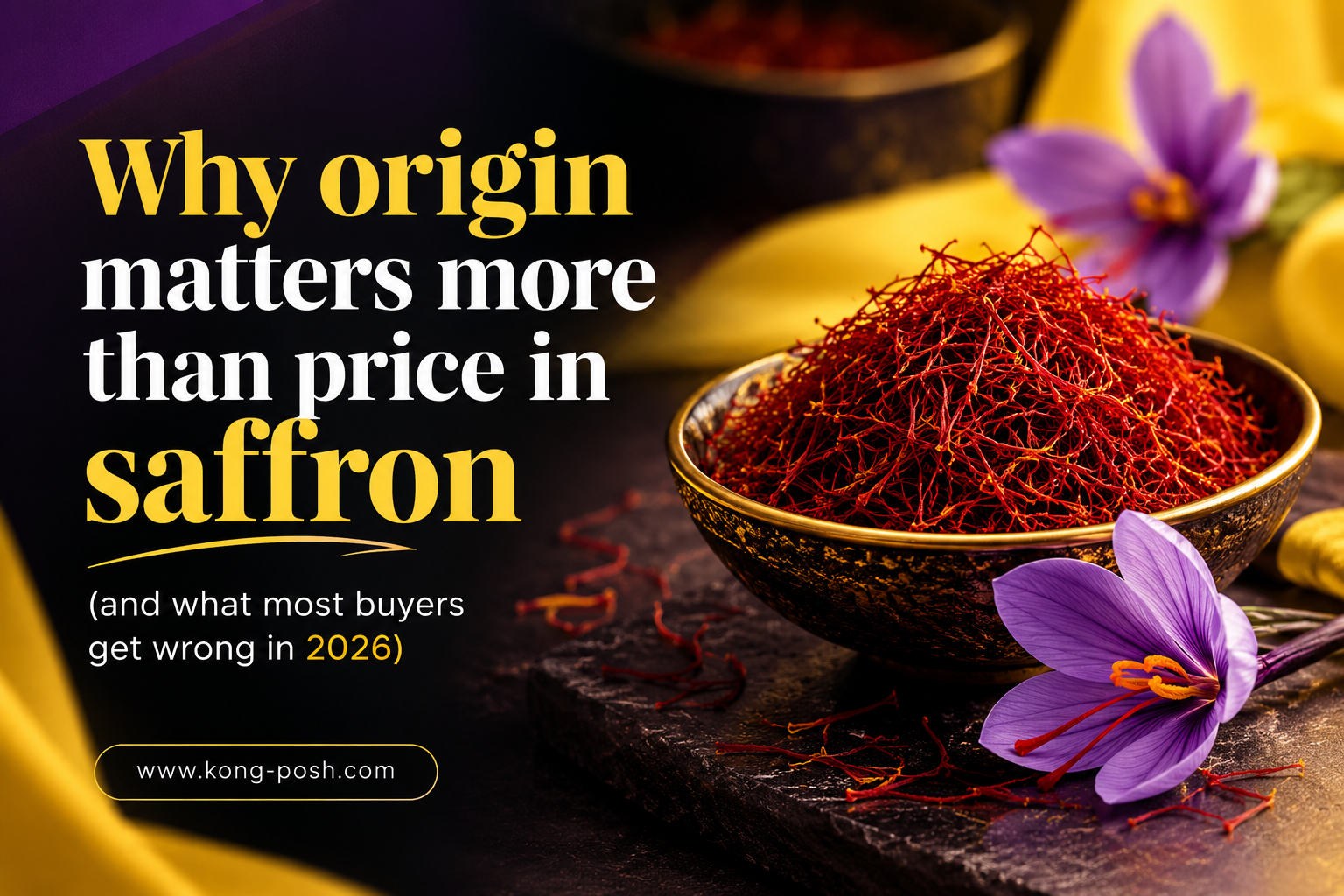
In a small stretch of land near Pampore, in the Kashmir valley, one family has walked the same saffron fields for seven generations. They know which slope catches the first October frost, which soil holds moisture without rotting the corms, and which hour of morning light makes the stigmas easiest to hand-pick without bruising them. None of that knowledge appears on a price tag. And that’s precisely the problem with how most people shop for saffron today.
The spice trade has trained buyers to equate a higher number with higher quality, or worse, a lower number with a better deal. Neither assumption holds up. Saffron is one of the most counterfeited agricultural products in the world, and a premium price does nothing to guarantee what’s inside the jar. Dyed corn silk, safflower petals, glycerin-coated threads, and saffron cut with cheaper Iranian stock sold under a Kashmiri label are all sitting on shelves right now, some of them priced higher than the genuine article.
Consider a buyer who paid a steep sum last winter for saffron marketed as “Kashmir Mongra,” the rarest grade, only to find threads that bled bright orange within seconds of touching water and left almost no aroma in the pot. That instant color release is a classic sign of artificial dye, not high crocin content. She’d trusted the price. She hadn’t asked where the saffron actually grew, who harvested it, or whether anyone could trace it back to a specific field. That single gap in due diligence cost her more than money; it cost her the dish she was cooking for a family gathering.
Origin isn’t a marketing word. It’s the entire explanation for why saffron from one region tastes, smells, and performs differently from saffron grown somewhere else. Kashmir’s saffron fields sit at an altitude of roughly 1,600 to 1,800 meters, with a specific combination of karewa soil, dry autumn air, and a narrow temperature window during flowering that few other regions on earth can replicate. Iranian saffron, grown at lower altitudes under different conditions, and Spanish saffron, often processed differently and sometimes re-exported under other names, are simply not the same product, even when the packaging suggests otherwise.
What separates a strong saffron harvest from a mediocre one often comes down to timing measured in hours, not days. A family that has worked the same fields for seven generations has an intuitive read on that timing that no agricultural manual fully captures. They know when to pick before the flower opens fully and loses potency to sunlight, how to separate the red stigma from the yellow style without crushing the delicate threads, and how to dry the saffron slowly enough to preserve its aromatic oils instead of scorching them into bitterness. This is inherited craft, refined across decades, and it shows up in the final cup of tea or plate of biryani far more than any price point does.
Heading into 2026, the mistakes buyers keep making are strikingly consistent. They trust the word “Kashmiri” on a label without checking for the Geographical Indication tag that legally certifies the saffron’s regional origin. They buy through marketplaces with no visible connection to an actual farm, trusting seller ratings over supply chain transparency. And they assume that because a product looks like the images they’ve seen of premium saffron, deep red threads, trumpet-shaped tips, it must be authentic, when in fact skilled counterfeiters have gotten very good at mimicking appearance while faking everything else.
The chemistry behind saffron quality is measurable, and it’s origin-dependent. Crocin gives saffron its color, safranal gives it aroma, and picrocrocin gives it the distinct bitter note experts look for. Genuine Kashmiri saffron, particularly Mongra grade, consistently tests at the higher end of international crocin standards set by ISO 3632, largely because of the altitude and soil conditions during growth. Saffron grown elsewhere, or diluted with lower-grade threads, simply cannot replicate those readings, no matter how the final product is priced or packaged.
This isn’t only a culinary distinction. Saffron’s therapeutic reputation, from mood support to its use in traditional wellness practices, depends on the concentration of these same active compounds. A jar of pale, low-potency threads offers little of the effect people are actually paying for, regardless of what the label claims. Origin determines potency. Potency determines whether the saffron does anything at all beyond adding a faint color to rice.
There are ways to protect yourself before you buy. Real saffron threads release color slowly into warm water or milk, taking several minutes to bloom rather than flooding the liquid instantly. The threads themselves should have a subtle, hay-like sweetness with a slightly bitter edge, not an overpowering, artificial fragrance. Ask any seller directly where their saffron is grown, whether they can name the farming family or region, and whether the product carries GI certification. A seller who can’t answer those questions plainly is telling you something important by staying vague.
This is exactly the standard we hold ourselves to at Saffron Cottage. We aren’t a trading company that sources from wherever prices are lowest that season. We are the growers, the same family that has worked these Kashmiri fields for seven generations, harvesting, hand-sorting, and packaging saffron from soil we know personally, not soil we’re told about secondhand. When we say Kashmiri, we mean it’s traceable to our own farms in the valley, tested for purity, and handled the way our grandparents handled it before us.
If there’s one thing worth carrying into how you buy saffron in 2026, it’s this: stop asking what it costs before you ask where it came from. Price is negotiable and easily manipulated. Origin is not. It’s written into the altitude, the soil, the hands that picked it, and the generations of knowledge behind the harvest. Buy from people who can prove that origin, not just promise it, and the price you pay will finally reflect something real.