
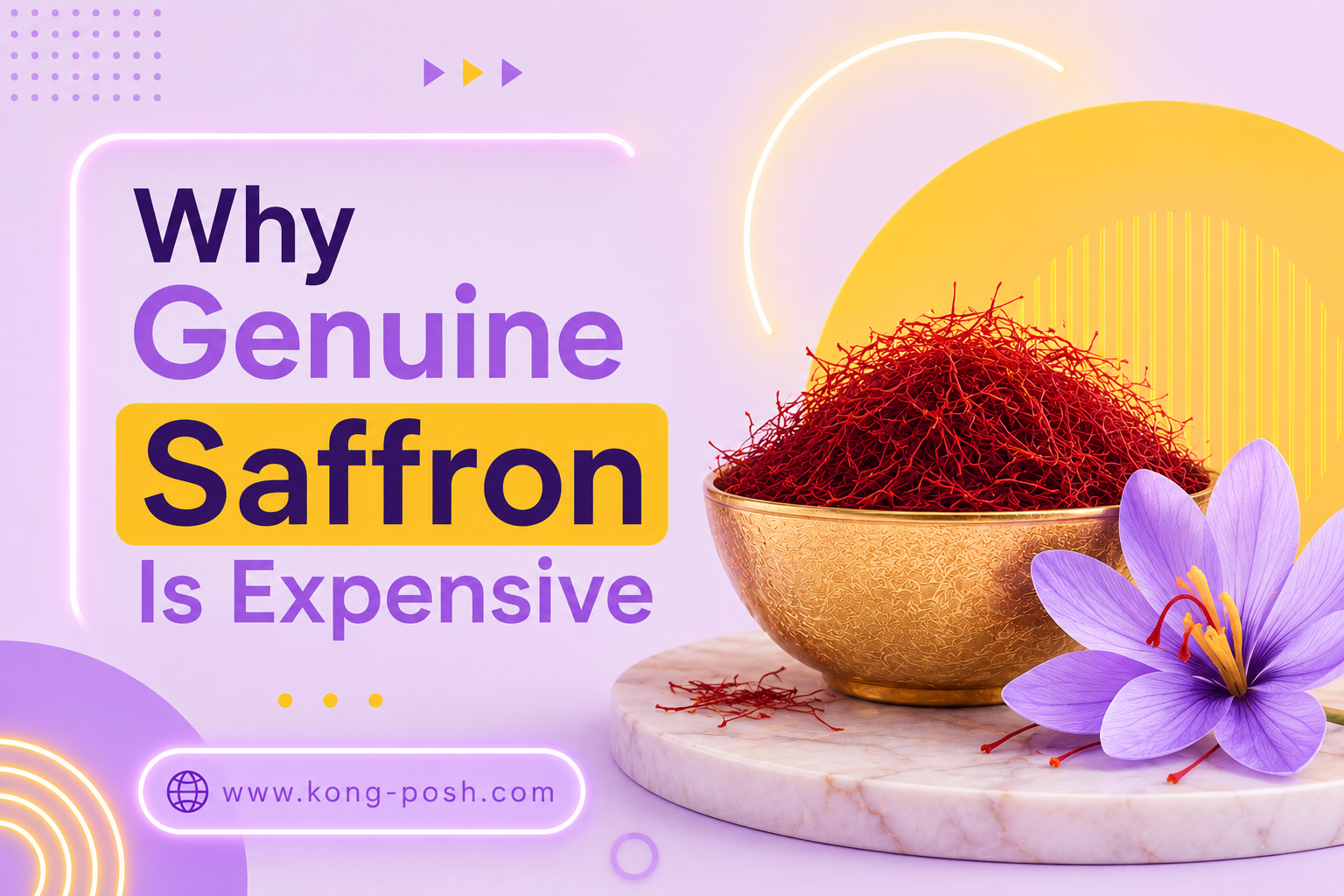
Saffron is often called the world’s most expensive spice, but that description only tells half the story. The more important question is: why is genuine saffron so expensive, and what are you actually paying for when you buy it?
If you have ever compared saffron prices online and wondered why one seller offers a gram at a surprisingly low price while another charges considerably more, you are not alone. The difference is not always simply about branding. It can come down to origin, harvesting, labour, quality, drying, storage, authenticity, and how much genuine saffron is actually inside the package.
For consumers, this matters more than ever. Saffron is a high-value spice and is particularly vulnerable to adulteration. Research has documented the use of other plant materials, dyes, old or spent saffron and other substances to imitate or increase the apparent quantity of saffron.
At Saffron Cottage, our story begins much closer to the source. We are growers of the finest Kashmiri saffron, harvesting from seven generations. That heritage gives us a very different perspective on saffron: it is not simply a luxury product sitting in a jar. It is an agricultural crop, a delicate harvest and a tradition that demands patience.
The short answer: why is saffron so expensive?
Genuine saffron is expensive because every flower produces only three saffron stigmas, and those delicate stigmas have to be harvested manually.
The production process is unusually labour-intensive. Saffron comes from the dried stigmas of the Crocus sativus flower. Each flower produces only three stigmas, meaning enormous numbers of flowers are required to produce relatively small quantities of finished saffron. ISO notes that the individual stigmas must be picked by hand, one by one.
That is the first reason genuine saffron costs more.
But it is not the only reason.
The final price can also reflect cultivation conditions, limited production, harvesting time, separation of the stigmas, drying, sorting, storage, testing, packaging and the risks involved throughout the supply chain.
In other words, when you buy genuine saffron, you are not paying simply for a spice.
You are paying for an extraordinarily small harvest produced through an extraordinarily careful process.
What makes genuine saffron different?
One of the biggest mistakes consumers make is judging saffron only by its colour.
Bright red threads can look impressive, but appearance alone cannot establish authenticity or quality.
Scientific quality assessment focuses on characteristic compounds including crocin, picrocrocin and safranal. Crocin is strongly associated with saffron’s colouring power, picrocrocin with its characteristic bitter taste, and safranal with its aroma. ISO 3632 provides internationally used specifications and test methods for saffron quality.
This is why a serious saffron buyer should ask more than:
“Is it red?”
A better set of questions is:
Where was it grown?
How was it harvested?
Is it genuine Crocus sativus?
Is it whole-thread saffron or powder?
How was it dried?
How was it stored?
Can the seller explain its origin?
Has the quality been properly evaluated?
These questions can help separate a premium agricultural product from something that merely looks like one.
The hidden labour behind one gram of saffron
Imagine standing in a saffron field during harvest season.
The flowers appear, but the valuable part is incredibly small.
The flower must be collected, the stigmas carefully separated, and the delicate material dried correctly. This cannot simply be treated like harvesting an ordinary high-volume crop.
That manual work is one of the fundamental reasons saffron commands such a high price. ISO specifically identifies the one-by-one hand harvesting of saffron stigmas as a major factor behind its value.
This is where the story of Saffron Cottage becomes personal.
For us, saffron is connected to generations of cultivation knowledge. Seven generations of harvesting is not a marketing shortcut; it represents accumulated agricultural experience, patience and respect for the crop.
A family that has worked with saffron across generations learns to appreciate details that are difficult to communicate through a price tag.
When should the flowers be harvested?
How should the delicate stigmas be handled?
How should they be dried?
How should they be protected after drying?
How should the finished saffron be stored?
Every one of these decisions can influence the final product.
Why harvesting at the right time matters
Saffron is not a crop where you can simply harvest whenever it is convenient.
The flowers have a limited flowering period, making timing extremely important.
The stigmas need to be handled carefully because quality can be affected during harvesting and processing. Research has also found that saffron characteristics can change with drying, storage, temperature and exposure to oxygen.
That means the journey from field to kitchen matters.
A premium saffron product is the result of multiple stages working together.
Cultivation.
Harvesting.
Separation.
Drying.
Sorting.
Storage.
Packaging.
Distribution.
A weakness at any stage can affect the final experience.
Why cheap saffron should make you ask questions
This does not mean that every inexpensive saffron product is automatically fake.
Prices can legitimately differ because of origin, grade, harvest year, purchasing volume, packaging, supply chain and seller margins.
But an unusually low price should encourage you to investigate rather than immediately celebrate the bargain.
Why?
Because saffron’s high economic value makes it an attractive target for adulteration. Research has documented adulteration involving materials such as safflower, calendula, turmeric, other plant parts, dyes and various substances used to increase weight or imitate saffron. Powdered saffron can be particularly vulnerable because foreign material can be mixed into it more easily.
The real question is therefore not:
“Why is genuine saffron expensive?”
It is also:
“How can some products claim to be genuine saffron at a price that seems too good to be true?”
That question deserves attention.
Why whole saffron threads are worth considering
When buying saffron, many consumers prefer whole threads rather than powder because the physical structure of the product is visible.
Powder can be convenient, but it also makes visual inspection more difficult. Research specifically identifies powdered saffron as a form particularly susceptible to adulteration.
Whole threads allow you to examine what you are buying.
That does not mean you can prove authenticity simply by looking at a thread. Laboratory methods remain important for rigorous authentication and quality assessment.
But transparency begins with giving consumers something they can actually see.
At Saffron Cottage, our connection to the crop means we believe consumers deserve to understand what is behind the product rather than simply being told that it is “premium.”
What does ISO 3632 mean for saffron buyers?
If you are serious about buying high-quality saffron, you may come across ISO 3632.
It is an international standard used for saffron specifications and testing. It evaluates characteristics related to saffron quality, including its colouring, flavour and aroma strength, as well as factors such as moisture and foreign matter.
The three compounds most commonly discussed in saffron quality are:
Crocin: associated with colouring strength.
Picrocrocin: associated with bitterness and flavour.
Safranal: associated with saffron’s characteristic aroma.
Laboratory assessment can provide information that appearance alone cannot.
This is particularly important in an age when consumers increasingly want traceability, authenticity and evidence rather than vague premium claims.
Kashmiri saffron has another story to tell
Origin matters.
“Kashmiri saffron” is not simply a phrase that should be added to a product label because it sounds premium.
Kashmir saffron has registered Geographical Indication status in India. The official GI record identifies “Kashmir Saffron” as a registered geographical indication covering Jammu & Kashmir.
For consumers, this reinforces an important principle:
Origin should mean something.
If a product is marketed specifically around geographical origin, buyers should look for credible information supporting that claim.
At Saffron Cottage, our brand is built around Kashmiri saffron and a seven-generation growing heritage. That connection to the source is central to our identity.
Why saffron is called red gold
The nickname “red gold” becomes easier to understand when you look beyond the price per gram.
Gold is valuable partly because it is scarce and difficult to obtain.
Saffron has a different story, but the comparison becomes understandable because the usable part of the crop is incredibly small and the production process is labour-intensive.
ISO has historically described saffron as the world’s most expensive spice and highlighted the enormous number of flowers required to produce relatively small quantities.
But there is another reason the comparison resonates.
Saffron combines scarcity with craftsmanship.
It is not mass-produced in the same way as many everyday spices.
That is precisely why buying decisions should be based on quality rather than simply the lowest price.
The biggest mistake consumers make when buying saffron
The biggest mistake is asking only:
“How much is one gram?”
Instead, ask:
“What am I getting for that gram?”
One gram of genuine, carefully produced saffron is not necessarily equivalent to one gram of a low-quality product.
The value can be influenced by:
Origin
Grade
Purity
Crocin strength
Aroma
Flavour
Moisture
Foreign matter
Harvest and processing practices
Storage conditions
Packaging
Traceability
Seller transparency
Laboratory testing where applicable
This changes the conversation from price to value.
And that is a much smarter way to buy saffron.
How to choose genuine saffron without falling for marketing
Consumers do not need to become saffron scientists to make better purchasing decisions.
Start with the basics.
Look for the real botanical identity
Genuine saffron comes from Crocus sativus.
If a seller cannot clearly explain what the product is, where it comes from or how it was produced, consider that a warning sign.
Prefer transparent origin information
If the product claims to be Kashmiri saffron, ask questions about its origin.
A trustworthy seller should be comfortable explaining where the saffron comes from.
Consider whole threads
Whole saffron gives you greater visibility than an anonymous powder.
Again, visual inspection is not a substitute for laboratory authentication, but transparency is valuable.
Ask about quality testing
For premium saffron, ask whether quality has been evaluated against recognized standards such as ISO 3632.
Do not assume that the phrase “Grade A” automatically means an internationally standardized quality category. Ask the seller what the grade actually means.
Pay attention to aroma
Genuine saffron has a distinctive aroma. But sensory checks alone cannot conclusively prove authenticity.
Use them as one part of your evaluation, not as your only test.
Think carefully about extreme discounts
A discount can be genuine.
But if the price appears dramatically lower than what the production process would reasonably suggest, investigate before buying.
Why modern saffron buyers are becoming more demanding
The saffron market is changing.
Consumers are increasingly interested in:
Traceability
Authenticity
Origin
Food quality
Responsible sourcing
Traditional farming
Laboratory testing
Transparent packaging
Direct-from-grower stories
Minimal processing
Premium culinary ingredients
This is part of a broader shift in food culture.
People want to know where their coffee comes from.
They want to know how their honey was produced.
They want to know the origin of their olive oil.
Saffron deserves the same level of curiosity.
The future of premium saffron is not simply about selling a beautiful box.
It is about proving the story behind what is inside.
Saffron Cottage: from generations of growing to your kitchen
This is where Saffron Cottage stands apart.
We are growers of the finest Kashmiri saffron, harvesting from seven generations.
Our story does not begin with a marketing campaign.
It begins with the crop.
It begins with generations of knowledge.
It begins with the belief that something this precious should be treated with patience and respect.
For Saffron Cottage, premium saffron is not about making the product sound expensive.
It is about helping customers understand why genuine saffron has value in the first place.
When you know what goes into producing saffron, the price becomes easier to understand.
And when you understand the difference between authenticity and appearance, you become a much smarter buyer.
Is expensive saffron always better?
No.
Price alone does not prove quality.
A higher price can reflect genuine quality, but consumers should still look for evidence.
Likewise, a lower price does not automatically mean a product is fake.
The smart approach is to evaluate the complete picture.
Origin.
Purity.
Quality.
Testing.
Harvesting.
Processing.
Storage.
Transparency.
Reputation.
That is far more meaningful than comparing two numbers on two websites.
Why the cheapest saffron can become the most expensive mistake
Imagine purchasing saffron because it is exceptionally cheap.
You use more than expected because the colour, aroma or flavour is weak.
The result is disappointing.
You buy another product.
You still do not get the depth of aroma or colour you expected.
Suddenly, the “cheap” saffron was not cheap at all.
This is why quality should be measured by performance, not just purchase price.
High-quality saffron can deliver powerful colour, distinctive aroma and characteristic flavour in very small quantities. Those properties are closely related to its chemical composition and are among the characteristics assessed in saffron quality standards.
The goal should not be to buy the cheapest saffron.
The goal should be to buy genuine saffron that delivers the value you expect.
What you should ask before buying saffron in 2026
The saffron market is becoming more sophisticated, so consumers should become more sophisticated too.
Before placing an order, ask the seller:
Where is the saffron grown?
Is it genuine Crocus sativus?
Is it whole-thread saffron?
What quality or grading system is being used?
Is laboratory testing available?
How is the saffron dried?
How is it stored?
What information is available about the harvest and origin?
Does the seller have a real connection to saffron cultivation?
Can the seller explain the product without hiding behind marketing language?
These questions can save you from making a purchase based solely on a photograph and an attractive price.
The real luxury is knowing what you are buying
Luxury is changing.
It is no longer only about expensive packaging, impressive labels or exclusive advertising.
For food products, real luxury increasingly means provenance, authenticity, craftsmanship and trust.
That is especially true for saffron.
A tiny quantity can represent an enormous amount of agricultural effort.
A few delicate threads can carry generations of knowledge.
And a small jar can connect a modern kitchen to an ancient farming tradition.
That is the real story behind saffron’s price.
The question is no longer “why is saffron expensive?”
The better question is:
“Is the saffron I am buying worth its price?”
That is where consumers need to become more careful.
Do not buy based on colour alone.
Do not buy based on the cheapest price.
Do not assume every “premium” label means the same thing.
Do not assume every product claiming to be Kashmiri saffron has the same provenance.
Ask questions.
Look for transparency.
Understand quality.
Choose sellers who can explain where their saffron comes from.
And whenever possible, buy from a source with a genuine connection to cultivation.
Choose the story behind the saffron
At Saffron Cottage, we believe that every thread should have a story worth knowing.
Seven generations of saffron-growing heritage.
Kashmiri origin.
A commitment to genuine saffron.
A connection between grower and consumer.
That is the difference between simply buying saffron and understanding what you are buying.
If you are searching for genuine Kashmiri saffron, do not make your decision on price alone.
Choose authenticity. Choose traceability. Choose generations of knowledge. Choose saffron with a story behind every thread.
Explore Saffron Cottage and discover the value behind genuine Kashmiri saffron.
Final takeaway
Genuine saffron is expensive because it is extraordinarily labour-intensive, produces very little usable spice from each flower, requires careful harvesting and processing, and has quality characteristics that depend on its chemical composition, handling and storage. Its high value also makes it a target for adulteration, making authenticity and transparency increasingly important.
So the next time you see a tiny box of saffron and wonder why it costs so much, remember what you are looking at.
You are not looking at an ordinary spice.
You are looking at thousands of delicate stigmas, careful agricultural work, generations of knowledge and a product whose value begins long before it reaches your kitchen.
And that is why genuine saffron is expensive.