
My grandfather used to hold a single thread of saffron up to the Pampore sun and tell me the light would not lie, even if the seller did. I was eight years old, standing in a field that my family has worked for seven generations, and I did not understand yet why he cared so much about a thread smaller than my little finger. I understand now. Saffron is the most expensive spice on earth by weight, and that price tag has turned it into one of the most counterfeited agricultural products in the world. Somewhere between the Kashmir Valley and your kitchen shelf, a shocking percentage of what gets sold as saffron has been cut, dyed, or replaced outright with something else entirely.
The scale of the problem is larger than most buyers assume. Industry investigations and customs seizures across Europe, the Gulf, and North America have repeatedly found that saffron ranks among the top three most adulterated food products globally, alongside olive oil and honey. Vendors stretch real saffron with safflower petals, corn silk dyed red, or beet fiber soaked in food coloring. Others sell genuine saffron that has been artificially weighted with glycerin or sugar syrup to inflate the sale weight. None of this shows up on a label. It shows up only when you know what to look for, and that knowledge is exactly what generations of saffron farmers like my family have had to protect, test, and pass down.
At Saffron Cottage, we have grown Kashmiri saffron on the same corms, in the same terraced fields of Pampore, since long before saffron became a global commodity traded on price rather than quality. Our family does not import, blend, or relabel saffron from other regions. We harvest the Crocus sativus flower by hand at dawn, separate the three crimson stigmas by hand, and dry them using methods refined across seven generations. That heritage matters here, because detecting fake saffron is not just a chemistry trick. It is a skill built on decades of handling the real thing until the fake becomes obvious by comparison.
The first and most reliable home test is the cold water test, and it takes less than fifteen minutes. Drop three or four threads of saffron into a glass of room-temperature or slightly warm water, then wait. Genuine saffron releases its golden-yellow color slowly, over several minutes, while the threads themselves remain intact and largely crimson. Fake or adulterated saffron, by contrast, bleeds color almost instantly, often turning the water deep red or orange within seconds. That rapid, aggressive color release is a dye doing its job too well. Real saffron’s coloring compound, crocin, works gradually and leaves the thread structure visibly whole even after soaking.
A second test builds on the first: taste and aroma. Authentic Kashmiri saffron carries a distinct bitterness from a compound called picrocrocin, paired with a faintly sweet, hay-like, almost metallic aroma that develops slowly on the tongue. Fake saffron, especially corn silk or safflower dyed with artificial coloring, tastes flat, slightly chemical, or oddly sweet with no bitterness at all. If you taste a thread and get an immediate burst of sweetness or nothing distinctive whatsoever, you are very likely holding a counterfeit. This is a test seasoned cooks in Kashmir perform instinctively, often before a dish even reaches the stove.
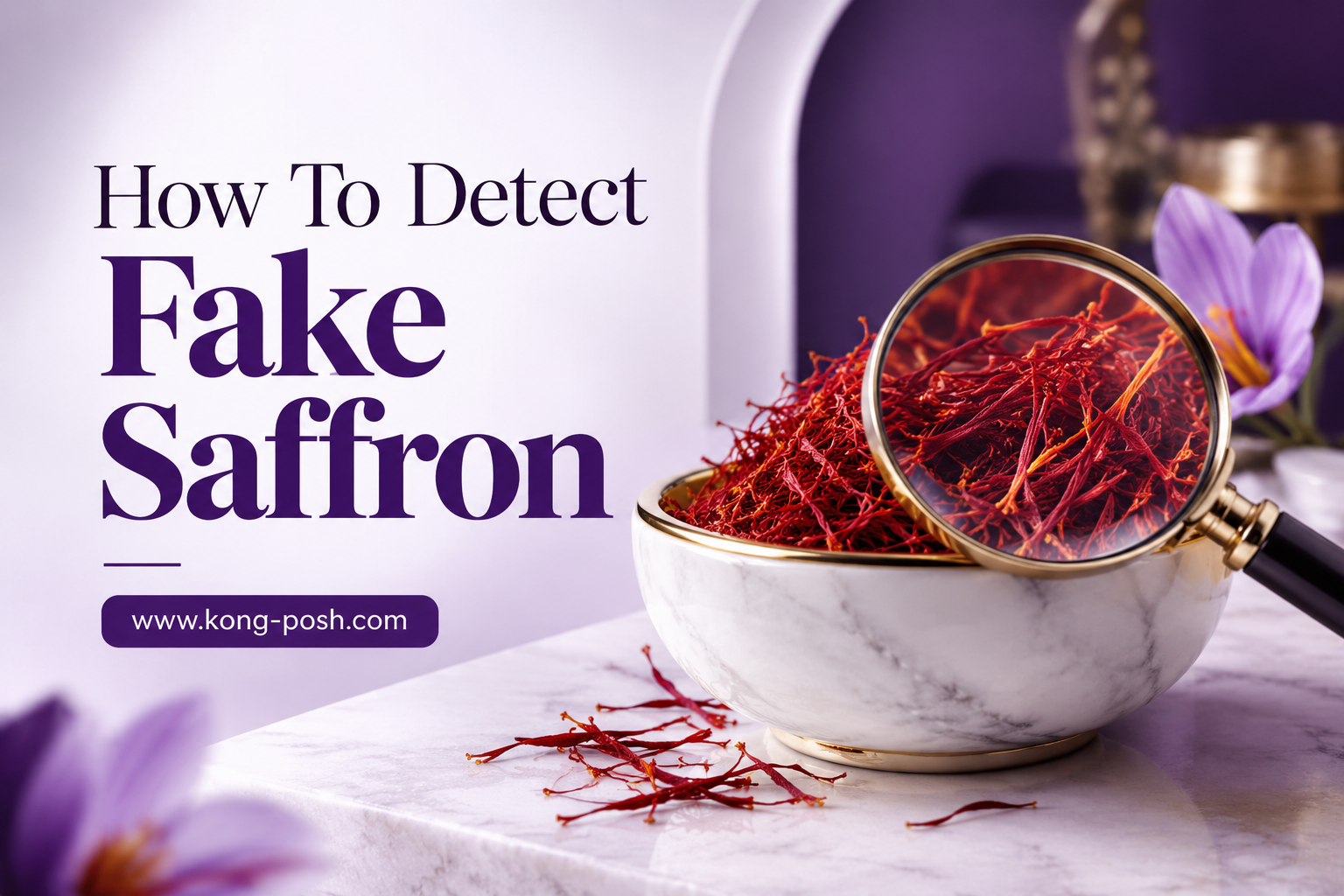
Visual inspection matters just as much as chemistry. Real saffron threads have a distinctive trumpet or funnel shape at one end, where the stigma was once attached to the flower’s style, and the color should shift subtly along the thread rather than appear uniformly bright red from tip to tip. Uniform, flat, matchstick-like threads with no structural variation are a red flag, often indicating dyed corn silk or shredded plant fiber cut to mimic saffron’s size. Genuine threads also feel slightly brittle and snap rather than bend, while fake fibers tend to be more rubbery or fibrous when you try to break them between your fingers.
Price is an uncomfortable but necessary indicator, and it deserves more attention than most buyers give it. Authentic Kashmiri saffron, specifically the variety carrying India’s Geographical Indication tag, requires roughly 150,000 flowers to produce a single kilogram of dried stigma, all harvested and processed by hand within a narrow autumn window. That labor cost does not disappear, no matter how aggressively a seller discounts the price. If you see Kashmiri saffron priced dramatically below the global market rate, the saffron itself is almost certainly not what the label claims, or it has been heavily cut with cheaper fillers to hit that price point.
For buyers who want certainty beyond home testing, laboratory verification exists and is worth understanding even if you never use it yourself. Spectrophotometry measures the concentration of crocin, picrocrocin, and safranal, the three compounds responsible for color, taste, and aroma respectively, and compares them against ISO 3632 standards that classify saffron into grades from Category I down to Category IV. Legitimate Kashmiri saffron sellers, including growers like us, are increasingly willing to share these lab results or batch certifications on request. A seller who cannot or will not provide any sourcing transparency, especially one selling at a premium “Kashmiri” label, should prompt more questions, not fewer.
This is precisely why sourcing directly from growers has become more than a preference for serious cooks and buyers. It has become a safeguard. When saffron passes through multiple intermediaries, each one blending, repackaging, or relabeling batches, the traceability that protects you as a buyer disappears. At Saffron Cottage, every batch we sell can be traced back to a specific harvest on our own fields in Pampore, handled by people whose families have done this work for generations. We are not interested in competing on price with mass-market blends, because that race inevitably ends in compromise, and compromise is exactly what fake saffron thrives on.
There is also a quieter, more personal reason this matters to us. Saffron has been the backbone of my family’s livelihood and identity for seven generations, through wars, droughts, and market crashes that nearly wiped out Kashmir’s saffron fields entirely. Every time a buyer unknowingly purchases dyed corn silk believing it to be Kashmiri saffron, it does not just cheat that household out of flavor and nutrition. It chips away at the reputation an entire region has spent centuries building. Protecting the authenticity of saffron is, in a real sense, protecting the people who still grow it the hard way, by hand, under the same autumn sky my grandfather once pointed toward.
Knowing how to detect fake saffron is no longer optional knowledge reserved for chefs and spice traders. It is a practical skill every household buying this spice should have, the same way people learned to check olive oil for purity or honey for added sugar. Run the water test. Taste a thread before committing to a dish. Examine the shape and texture closely. Question a price that seems too generous to be true. And whenever possible, buy from growers who can tell you exactly which field, which harvest, and which hands your saffron passed through. At Saffron Cottage, that transparency is not a marketing promise. It is simply how saffron has always been grown in our family, thread by thread, generation after generation.