
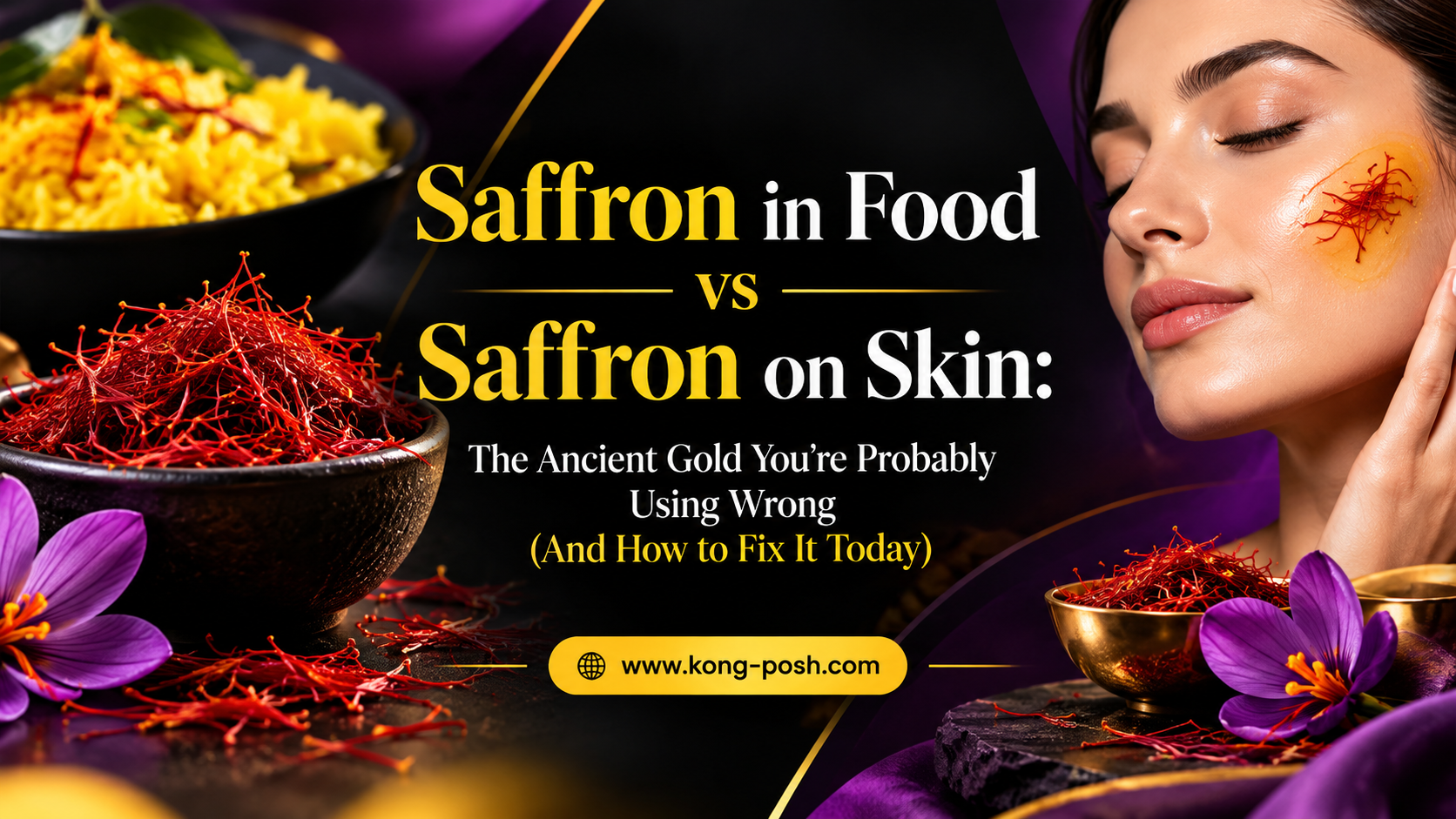
If you have ever added a strand of saffron to your milk at night and then wondered whether you could just crush the same strand into your face pack the next morning, you are not alone. This is one of the most searched, most misunderstood questions about saffron today, and honestly, most people are getting the answer wrong.
Saffron has quietly become one of the biggest names in both the wellness aisle and the skincare aisle. It shows up in golden lattes, in bridal skincare routines, in luxury serums, and in your grandmother’s kitchen jar all at once. But here is the part nobody tells you clearly: saffron for eating and saffron for skin are not interchangeable in the way you think, and using the wrong grade, the wrong quantity, or the wrong method can either waste your money or, worse, irritate your skin.
At Saffron Cottage, we have been growing and harvesting the finest Kashmiri saffron for seven generations. Saffron is not a trend for us. It is what our family has lived and worked around since long before it became a skincare buzzword. So we want to walk you through exactly how saffron behaves inside your body versus on your skin, where people go wrong, and how you can start using it correctly starting today.
Why everyone is suddenly talking about saffron again
Saffron has always been called red gold, but 2026 has pushed it into a completely new spotlight. Skincare experts are calling this a shift toward ingredients that are backed by tradition and by science at the same time, rather than another overnight viral fad. Clean beauty formulators are actively increasing saffron in serums, oils, and brightening elixirs because of its natural bioactive compounds like crocin, safranal, and kaempferol, which are known to support pigmentation correction, dullness reduction, and a more even tone.
At the same time, saffron demand in wellness is climbing because of its long-established role in mood support, digestion, and antioxidant intake. So you have two industries pulling saffron in two different directions, food and skincare, and most consumers are stuck in the middle without clarity. This blog is here to give you that clarity, in plain language, without overselling anything.
Saffron in food: what it actually does inside your body
When you consume saffron, whether in milk, tea, rice, or a dessert, it interacts with your digestive system and bloodstream. Culinary saffron is generally used in very small quantities, typically just a few strands per serving, because its flavour and color are extremely concentrated. A little goes a long way, and using more does not mean more benefit. In fact, overusing saffron internally without guidance is one of the most common mistakes home cooks and wellness users make.
Good quality Kashmiri saffron, like the kind harvested from the Pampore fields our family has worked for generations, has deep red stigmas, a strong aroma, and a naturally sweet, slightly bitter taste. Cheaper or adulterated saffron sold in mass markets often looks similar but lacks the same potency, which means people end up using more of it to get any color or flavour at all, and unknowingly consuming filler material instead of real saffron.
The biggest mistake here is buying saffron purely based on price. Real saffron is expensive because each flower produces only three delicate stigmas that must be hand-picked, and the harvesting window lasts only a few weeks each year. If a deal looks too cheap to be true, it usually is.
Saffron on skin: why it behaves completely differently
Now here is where most people slip up. Skin does not process saffron the same way your gut does. When applied topically, saffron needs to be used in the right concentration and combined with the right carrier, such as milk, honey, aloe vera, or a proper cosmetic-grade formulation, so that its antioxidant properties can actually reach the skin barrier without causing irritation.
Using raw culinary saffron strands directly and aggressively on the skin, especially in high quantity or with no dilution, can sometimes cause redness or sensitivity for people with reactive skin. This does not mean saffron is bad for skin. It means saffron for skin needs to be treated with the same respect and precision as any active skincare ingredient, not tossed on like a garnish.
This is exactly why the skincare industry has moved toward using purified saffron extracts, oils, and serums rather than asking people to grind raw threads at home. It is safer, more consistent, and actually more effective, because the formulation controls the exact dosage your skin receives.
The mistake almost everyone makes with saffron
Here is the honest truth. Most people buy one jar of saffron and try to use it for everything, cooking, skincare, hair masks, and even bathing, without realizing that quality, freshness, and concentration matter enormously depending on the use case. Saffron that has been sitting exposed to air and light for months loses its potency fast, whether you are drinking it or applying it.
If your saffron milk tastes weak or your homemade face mask is not showing any glow, the problem is rarely the recipe. It is almost always the saffron itself, either it is old, it is low grade, or it was never real Kashmiri saffron to begin with.
How to fix this today
The good news is that fixing this does not require a complicated routine overhaul. It requires better sourcing and a little bit of intention.
First, always check the origin. Genuine Kashmiri saffron has a distinct deep crimson color, a strong honey-like aroma, and threads that are trumpet shaped at the tip. If your saffron looks flat, orange, or oddly uniform, it is likely not authentic.
Second, separate your usage. Keep a portion for culinary use in your kitchen, used sparingly in warm milk, rice, or tea, and use a dedicated saffron-infused skincare product or a properly diluted saffron and milk paste for your skin, rather than applying raw kitchen saffron directly and generously to your face.
Third, buy from a source you can trust, ideally one that harvests saffron itself rather than reselling it through multiple middlemen. This is precisely why we started Saffron Cottage. Our family has been growing saffron in the Kashmir valley for seven generations, and we harvest, dry, and pack it ourselves so you know exactly what you are getting, with no dilution and no shortcuts.
Why sourcing matters more than any skincare hack
There is a reason old family businesses in saffron regions guard their harvest so carefully. The saffron crocus flower blooms for only a short window each autumn, and every stigma has to be plucked by hand within hours of the flower opening to preserve its color, aroma, and active compounds. This is not something that can be rushed or mass produced without losing quality.
When you choose saffron from a grower with generational expertise instead of a random online listing, you are not paying for marketing. You are paying for authenticity, freshness, and a supply chain that has not been stretched or adulterated along the way. Whether you plan to use it in your morning chai or in your evening skincare ritual, the source is where everything else starts.
The real cost of waiting
Saffron prices have been climbing steadily due to limited global supply, rising production costs, and growing demand from both the wellness and beauty industries. Genuine Kashmiri saffron in particular is becoming harder to source at fair prices as international demand increases. If you have been putting off switching to authentic saffron because you assumed you already had “good enough” saffron at home, this is the moment to actually check what is sitting in your kitchen jar.
The saffron you use today shapes the results you see next month, whether that is in your skin’s tone and texture or in how your body responds to it internally. Waiting rarely makes saffron cheaper or easier to find. It usually just means settling for lower quality for longer.
Bringing it back to your daily routine
You do not need to overhaul your entire routine overnight. Start small. Replace your regular saffron with a verified, single-origin Kashmiri saffron for your food. Introduce a saffron-based skincare product, or a gentle homemade saffron and milk mask twice a week, and observe how your skin responds over a few weeks rather than expecting overnight results. Saffron is a slow, consistent worker, not an instant fix, whether you are eating it or applying it.
At Saffron Cottage, we have watched families use the same saffron traditions for generations, in the kitchen and in skincare rituals passed down from mothers and grandmothers. The wisdom was never wrong. It just needs to be paired with the right quality and the right method for today’s world.
Ready to actually get it right
If you are serious about seeing real results, whether in your food or on your skin, the first step is making sure the saffron in your hand is genuine, fresh, and ethically harvested. Explore our small-batch, 7th-generation Kashmiri saffron at Saffron Cottage and feel the difference between marketing and the real thing. Your kitchen and your skin both deserve the authentic version, not the diluted one.