
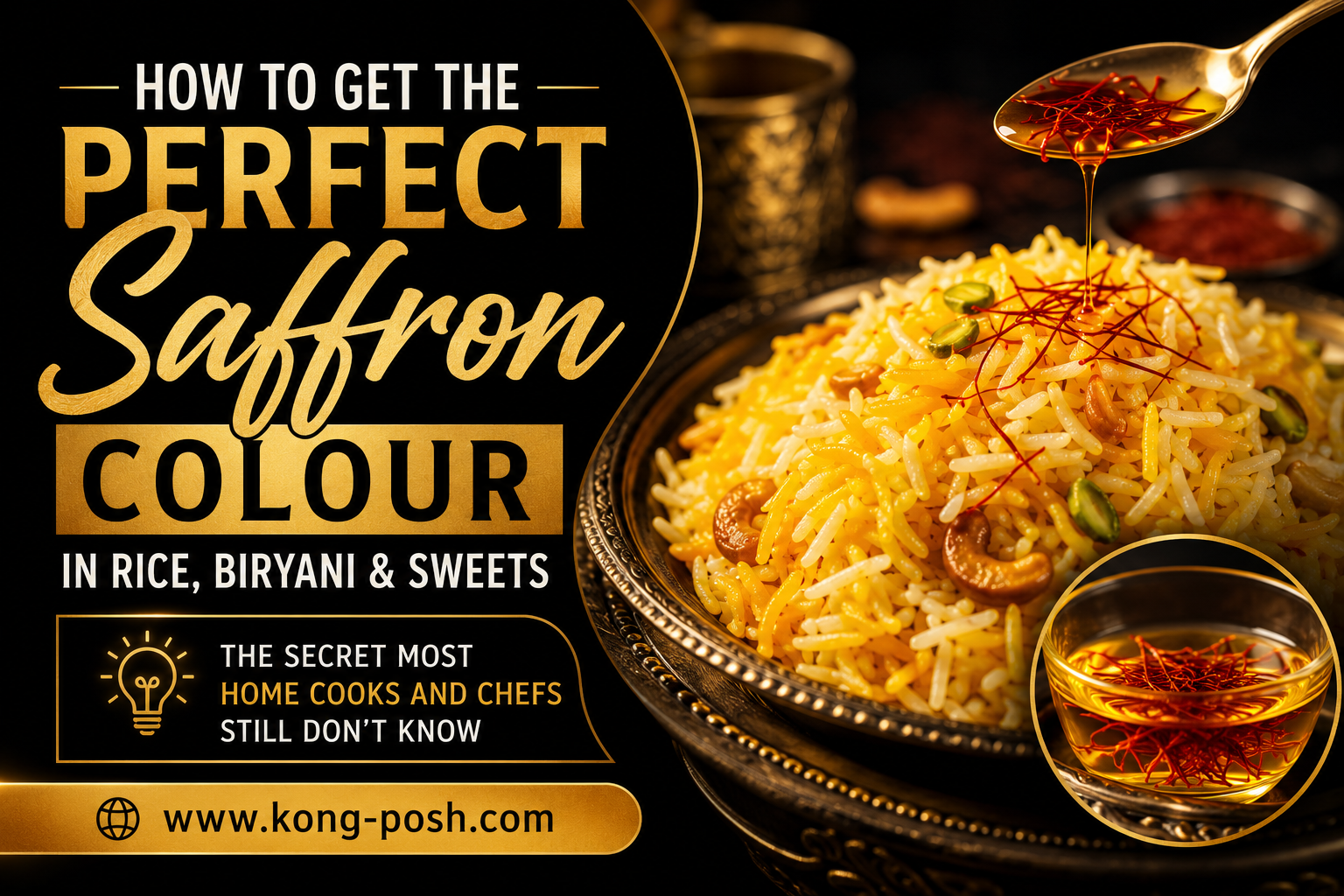
Have you ever wondered why restaurant biryani has that beautiful golden colour while homemade biryani often looks pale, uneven, or artificially yellow? Or why traditional Kashmiri desserts glow with a luxurious golden hue without using food colouring?
The answer is not expensive equipment or secret ingredients. It is authentic saffron, proper preparation, and patience.
Today, more people are searching for natural ingredients instead of artificial food colours. Health-conscious families, professional chefs, food bloggers, restaurants, and home bakers are replacing synthetic colouring with genuine Kashmiri saffron because it delivers something artificial colours never can: natural beauty, unforgettable aroma, rich flavour, and health benefits in a single ingredient.
If you want your biryani, pulao, kheer, milk cake, rasmalai, phirni, saffron milk, or festive sweets to look as beautiful as they taste, this guide will show you exactly how professionals achieve that luxurious golden finish.
Why does authentic saffron create a better colour?
Saffron is often called the world’s most valuable spice because every strand is harvested by hand from the Crocus sativus flower.
The beautiful golden-red colour comes from natural compounds called crocin.
Unlike artificial colouring, crocin produces:
- Rich golden appearance
- Even colour distribution
- Pleasant aroma
- Natural flavour enhancement
- No chemical aftertaste
This is why premium restaurants around the world continue using genuine saffron instead of synthetic food colours.
The biggest mistake people make
One of the most common mistakes is sprinkling dry saffron directly into rice or desserts.
This wastes both colour and flavour.
Authentic saffron must first be activated.
Without activation, much of its natural colour remains trapped inside the delicate threads.
The professional method for releasing maximum saffron colour
Professional chefs follow a simple process.
Step 1: Use authentic saffron
Quality matters more than quantity.
Fresh Kashmiri saffron produces deeper colour than old or low-grade saffron.
Thin, broken, faded, or mixed saffron threads rarely produce impressive results.
Step 2: Crush gently
Instead of using whole strands, lightly crush them using a mortar and pestle or between two spoons.
This increases the surface area.
More colour is released.
More aroma develops.
Step 3: Soak before cooking
Never skip soaking.
Place crushed saffron into:
- Warm milk
- Warm water
- Warm cream
Leave it for 15 to 30 minutes.
Many professional chefs wait even longer because extended soaking extracts even richer colour.
Step 4: Add at the right time
Timing matters.
For biryani:
Add saffron milk during the final layering before dum cooking.
For rice:
Mix saffron water after the rice is nearly cooked.
For sweets:
Add saffron infusion near the finishing stage to preserve aroma
Why restaurant biryani looks different
Professional kitchens avoid mixing saffron throughout the rice.
Instead, they drizzle saffron milk unevenly over layered rice.
During slow cooking, the colour spreads naturally.
The result is stunning.
Some grains remain white.
Some become golden.
Others become deep orange-yellow.
This natural contrast makes premium biryani visually attractive.
Should you use food colouring with saffron?
Authentic chefs say no.
Real Kashmiri saffron already provides natural colour.
Artificial colouring only creates brightness without aroma or flavour.
Consumers today increasingly prefer foods coloured naturally rather than chemically.
Natural ingredients also improve customer confidence in restaurants and food businesses.
Which dishes benefit most from saffron?
Authentic saffron enhances numerous recipes.
Rice dishes include:
- Chicken biryani
- Mutton biryani
- Vegetable biryani
- Pulao
- Persian rice
- Arabic rice
- Kashmiri rice
Desserts include:
- Kheer
- Rasmalai
- Phirni
- Kulfi
- Ice cream
- Milk cake
- Gulab jamun syrup
- Shahi tukda
- Basundi
Drinks include:
- Saffron milk
- Kashmiri Kahwa
- Lassi
- Milkshakes
Bakery products include:
- Cakes
- Cookies
- Cheesecakes
- Bread
- Macarons
- Luxury chocolates
How much saffron should you use?
Many people believe using more saffron automatically creates better colour.
This is incorrect.
Authentic saffron is highly concentrated.
Only a small amount is needed.
Using excessive saffron may overpower the dish and reduce flavour balance.
Premium quality saffron performs better because every strand contains more natural colouring compounds.
Why freshness changes everything
Fresh saffron releases:
- Richer aroma
- Better flavour
- Stronger colour
- Higher crocin content
Old saffron gradually loses its natural oils.
Even if it looks similar, the colour becomes weaker over time.
Proper storage is equally important.
Keep saffron:
- Away from sunlight
- In an airtight container
- In a cool, dry place
- Away from moisture
Why Kashmiri saffron is gaining worldwide attention
Food lovers around the world are increasingly searching for authentic Kashmiri saffron because of its exceptional characteristics.
Premium Kashmiri saffron is known for:
- Long, thick red stigmas
- Powerful aroma
- Rich colouring strength
- Superior flavour
- High natural crocin levels
As consumers become more aware of food quality, demand for genuine saffron continues to grow across Malaysia, the Middle East, Europe, and beyond.
The growing trend toward natural luxury ingredients
Modern consumers no longer buy food based only on taste.
They look for:
- Natural ingredients
- Clean labels
- Authentic sourcing
- Traditional farming
- Premium quality
- Sustainable production
Luxury spices are becoming part of everyday cooking because people understand that quality ingredients transform ordinary meals into memorable experiences.
Instead of adding artificial colours, more families now choose genuine saffron to create healthier and more elegant dishes.
Why choose Saffron Cottage?
At Saffron Cottage, we are not traders purchasing saffron from unknown suppliers.
We are proud growers of the Finest Kashmiri Saffron, harvesting through seven generations of family tradition.
Every strand reflects decades of farming knowledge, careful hand harvesting, meticulous drying, and strict quality standards. This commitment allows us to deliver saffron with exceptional colour, aroma, and flavour that enhances every recipe naturally.
Whether you are preparing biryani for your family, creating premium desserts for customers, or developing signature restaurant dishes, authentic saffron makes a noticeable difference in both appearance and taste.
When quality matters, choosing saffron directly from experienced growers gives you confidence that every meal showcases the richness and authenticity of true Kashmiri saffron.
Final thoughts
The perfect saffron colour is never achieved by adding artificial yellow colouring or using large amounts of spice.
It comes from understanding the ingredient, respecting traditional preparation methods, and choosing authentic premium-quality saffron.
As more consumers embrace natural cooking and premium ingredients, genuine Kashmiri saffron is becoming an essential part of modern kitchens. Whether you’re preparing a festive biryani, a comforting bowl of kheer, or an elegant dessert, authentic saffron brings together vibrant colour, irresistible aroma, and rich flavour in a way that no artificial substitute can match.
If you want every meal to leave a lasting impression, start with the ingredient that has been treasured for centuries.
Choose authenticity. Choose tradition. Choose excellence.
Choose Saffron Cottage, where seven generations of Kashmiri saffron farming continue to bring nature’s finest spice from our fields to your kitchen.
Call to action
Ready to transform your rice, biryani, sweets, and desserts with authentic natural colour?
Experience the difference that genuine Kashmiri saffron can make.
Order premium saffron from Saffron Cottage today and discover why chefs, food lovers, and families trust saffron grown by seven generations of dedicated growers. Taste the purity, enjoy the aroma, and create dishes that look as extraordinary as they taste.