
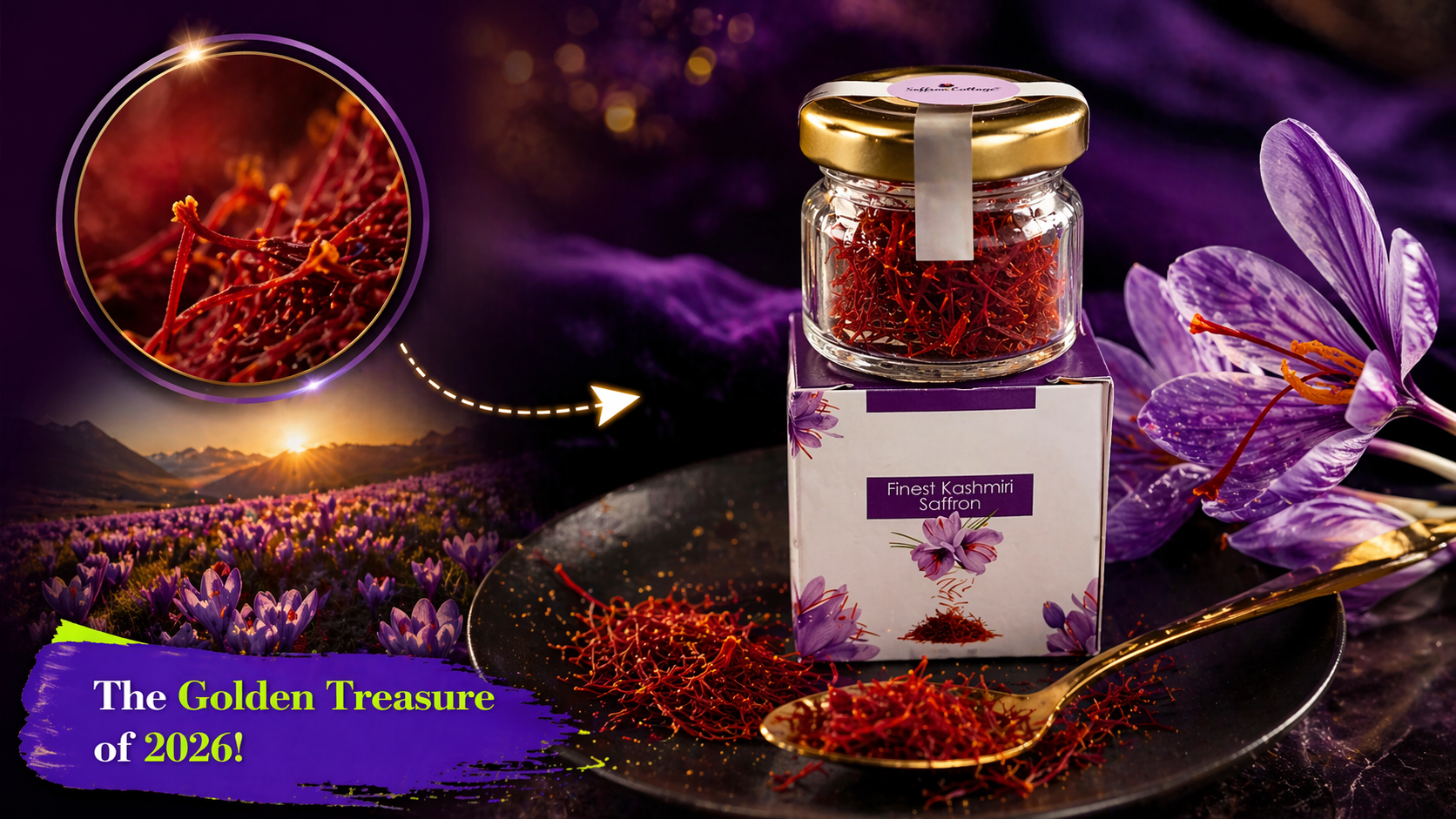
In the rarefied world of global luxury, few commodities possess the historical weight, culinary prestige, and biological potency of Kashmiri Saffron. As we navigate the landscape of 2026, where “quiet luxury” has evolved into “conscious indulgence,” this vibrant crimson spice—often called Red Gold—has emerged as the ultimate symbol of status and well-being.
At the heart of this revolution is Saffron Cottage, a name now synonymous with the uncompromised purity of the Pampore highlands. This comprehensive guide explores why Kashmiri Saffron remains the world’s most expensive and coveted spice, and how it is being reimagined for the modern connoisseur.
The Mystique of Red Gold: Why Kashmiri Saffron is Peerless
To understand the value of Kashmiri saffron, one must look beyond the kitchen. In 2026, luxury is defined by provenance, scarcity, and efficacy. Kashmiri saffron (Crocus sativus Cashmirianus) satisfies all three with a profile that no other region—be it Iran, Spain, or Greece—can replicate.
The Botanical and Chemical Edge
While Iran produces nearly 90% of the world’s saffron, Kashmir produces the world’s finest. The chemical composition of the Kashmiri variety is objectively superior, characterized by significantly higher levels of three key compounds:
- Crocin (Coloring Strength): Responsible for the deep pigment. Kashmiri saffron averages a crocin content of 8% to 12%, compared to 6% in Iranian varieties.
- Safranal (Aroma): The compound that gives saffron its “honey and hay” scent.
- Picrocrocin (Flavor/Bitterness): The marker of medicinal potency.
The “Karewa” Factor: Soil and Soul
The secret lies in the Karewa soil of Pampore. These are ancient lacustrine deposits (lake-bed sediments) that are exceptionally rich in minerals and offer perfect drainage. Combined with an altitude of 1,600 to 2,000 meters, the plants are subjected to the ideal degree of “cold stress,” which forces the flower to concentrate its bioactive compounds.
Saffron Cottage: A Legacy of Purity and Ethics
In an era of mass production, Saffron Cottage stands as a guardian of tradition. Sourcing directly from the sun-drenched fields of Pampore, the brand bridges the gap between 7th-generation farmers and the global luxury market.
The Vertical Integration Difference
Unlike “white-label” brands that buy bulk saffron from traders, Saffron Cottage maintains a farm-to-table philosophy. This ensures:
- Zero Adulteration: No dyed corn silk, no floral waste, and no added moisture to increase weight.
- Ethical Harvesting: Each flower is hand-picked at dawn before the sun can degrade the volatile oils.
- GI-Tagged Authenticity: Every gram carries the Geographical Indication (GI) tag, a legal certification of its Kashmiri origin.
“Our mission at Saffron Cottage is not just to sell a spice, but to preserve a heritage. In 2026, the world seeks truth in what they consume. We provide that truth in every thread.” — Saffron Cottage Ethos
The 2026 Luxury Trend: Saffron as a Status Symbol
The luxury market in 2026 has shifted from “conspicuous consumption” to “meaningful investment.” Saffron has moved from the spice rack to the center of high-end lifestyle sectors.
Saffron in “Clean Beauty” and Perfumery
High-end cosmetic brands are increasingly utilizing the Mongra grade of saffron for its brightening and anti-aging properties. Saffron Cottage’s extracts are now a staple in bespoke skincare formulations that target hyperpigmentation and oxidative stress.
The Rise of “Saffron Wellness”
Bio-hacking and longevity are the new frontiers of luxury. Connoisseurs are no longer just looking for taste; they are looking for the neuroprotective benefits of Kashmiri saffron.
| Feature | Kashmiri Saffron (Saffron Cottage) | Standard Iranian Saffron |
| Color | Deep Maroon/Dark Red | Bright Red to Orange |
| Thread Shape | Long, thick, trumpet-shaped | Shorter, thinner |
| Crocin Levels | 8-12% (Exceptional) | 6-9% (Good) |
| Aroma | Heady, floral, complex | Mild, earthy |
Health and Wellness: The Bioactive Powerhouse
Modern clinical research in 2025 and 2026 has solidified what Ayurveda has claimed for millennia: Saffron is a potent medicine.
1. The “Natural Prozac”
Recent studies from Monash University and other global institutes have shown that 30mg of saffron daily is as effective as certain pharmaceutical antidepressants in treating mild-to-moderate depression, with significantly fewer side effects. It works by modulating neurotransmitters like serotonin and dopamine.
2. Cognitive Longevity and Eye Health
Saffron is rich in carotenoids that cross the blood-brain barrier. It is being used as a supportive therapy for:
- Age-Related Macular Degeneration (AMD): Protecting retinal cells from oxidative damage.
- Alzheimer’s Support: Inhibiting the aggregation of amyloid-beta plaques in the brain.
3. Metabolic Health
For the 2026 wellness-seeker, saffron is a tool for blood sugar regulation. It helps improve insulin sensitivity and reduces cravings, making it a “luxury supplement” for weight management.
Culinary Excellence: Mastering the Mongra Grade
In the kitchen, the Mongra grade—which consists only of the dark red tips of the stigma—is the gold standard.
The Art of the Saffron Infusion
To unlock the full potential of Saffron Cottage’s threads, one must avoid direct heat.
- Grind: Use a mortar and pestle with a pinch of sugar or salt.
- Bloom: Add the powder to warm water (not boiling) or milk for 20 minutes.
- Incorporate: Add the “liquid gold” to your dish in the final stages of cooking.
Modern 2026 Pairings
- Saffron and White Chocolate: A pairing dominating high-end patisseries.
- Saffron-Infused Seafood: Enhancing the natural sweetness of scallops and lobster.
- The Saffron Gin-and-Tonic: A staple in luxury mixology for 2026.
The Authenticity Guide: How to Spot the Fake
With prices for Kashmiri saffron reaching record highs in 2026, the market is flooded with counterfeits. Saffron Cottage advocates for consumer education.
The 15-Minute Water Test
Drop 3-4 threads of Saffron Cottage Mongra into a glass of cold water.
- Real Saffron: Will slowly release a golden-yellow hue. The threads will remain vibrantly red.
- Fake Saffron: Will immediately bleed a deep red/orange color (due to dyes). The threads will turn white or grey within minutes.
The Taste and Smell Paradox
- Smell: Real saffron smells like a mixture of honey and hay—sweet, but pungent.
- Taste: Real saffron must taste bitter. If it tastes sweet, it has been coated in sugar or honey to add weight.
Sustainability and the Future of Saffron
As we look toward the late 2020s, the challenges of climate change are real. Saffron Cottage is leading the way in Sustainable Saffron Farming. By implementing drip irrigation and organic composting, they are ensuring that the Karewa soil remains fertile for the 8th generation of farmers.
The 2020 GI Tagging was a turning point, protecting Kashmiri farmers from being undercut by lower-quality imports. Today, buying from Saffron Cottage is an act of supporting a sustainable ecosystem that preserves one of the world’s most delicate crops.
Conclusion: Investing in Your Well-being
Kashmiri Saffron is more than a spice; it is a multi-sensory experience that combines history, health, and haute cuisine. In 2026, as the world moves faster, the slow, hand-harvested nature of Saffron Cottage’s Red Gold offers a moment of pure, authentic luxury.
Whether you are seeking to elevate your culinary creations, brighten your skin, or support your mental health, the finest Kashmiri saffron remains the ultimate “Golden Treasure.”