
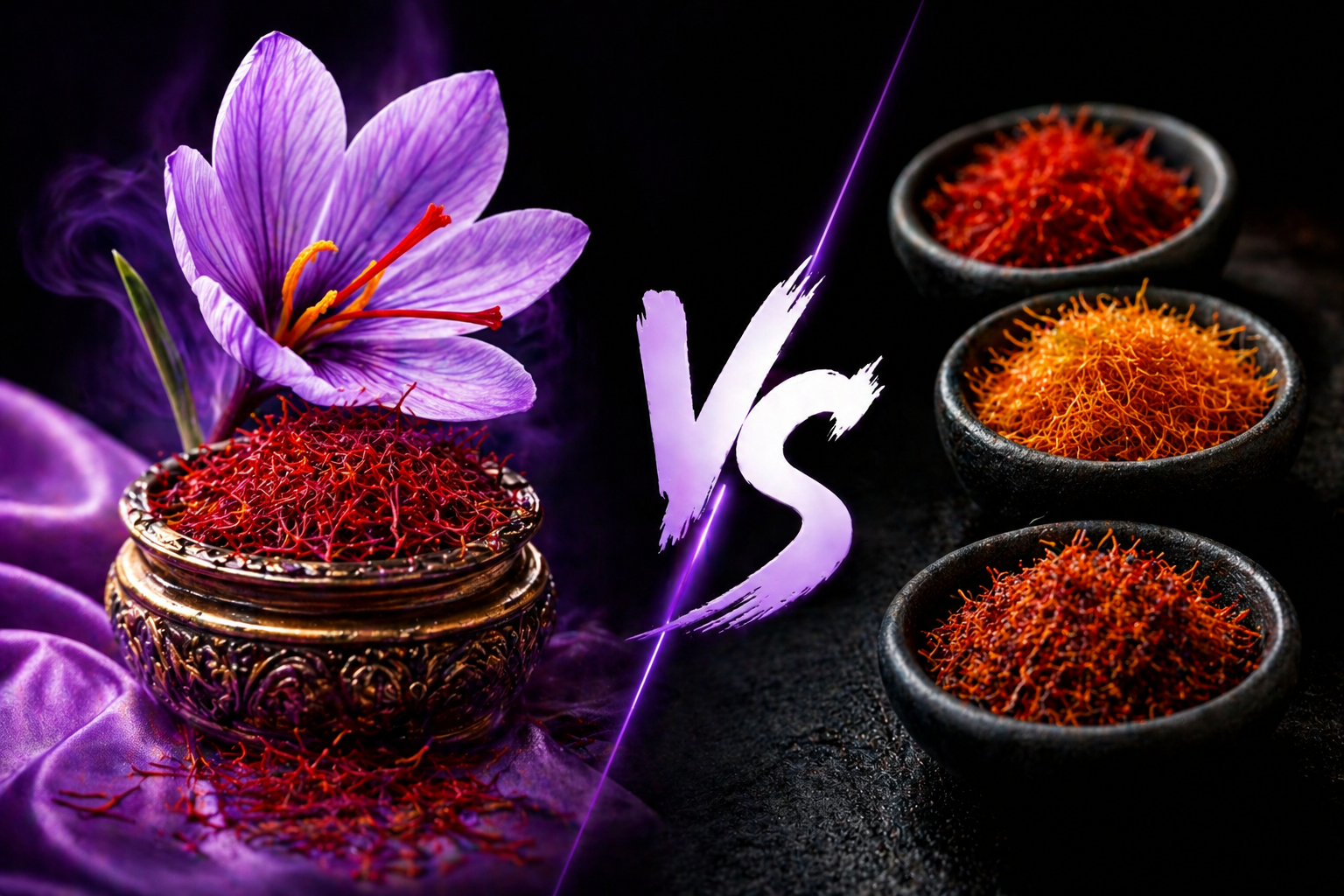
In the high-altitude plateaus of the Kashmir Valley, where the air is crisp and the mountains stand as silent sentinels, a miracle unfolds every autumn. This is the blooming of the Crocus sativus, the flower that gives the world its most expensive spice: saffron. But not all saffron is created equal. While the global market is flooded with varieties from Iran, Spain, and Greece, Kashmiri Saffron remains the undisputed “Red Gold,” a title earned through a unique combination of geography, chemistry, and centuries of tradition. At Saffron Cottage, we believe that understanding this difference is more than just a culinary lesson; it is a journey into the soul of the Valley.
The Heritage of the Valley: A Legacy Written in Crimson
To understand why Kashmiri saffron is the finest, one must first look at its history. While some historians suggest that saffron was brought to India by Persian missionaries in the 11th or 12th century, local Kashmiri folklore tells a different story. They speak of two Sufi saints, Sheikh Sharif-ud-Din and Mir Sayyid Ali Hamadani, who gifted a saffron bulb to a local chieftain after being cured of a sickness.
Regardless of its origin, the people of Pampore—the “Saffron Town” of Kashmir—have perfected the art of cultivation over a millennium. This legacy is not merely about farming; it is a cultural ritual. The harvest is a communal event where families gather under the autumn sun to hand-pick millions of flowers. This deep-rooted heritage ensures that every thread of Kashmiri saffron carries the weight of a thousand years of expertise, a level of artisanal care that industrial-scale producers in other parts of the world simply cannot replicate.
The Geography of Perfection: Why Pampore Is Irreplaceable
Geography is the silent architect of quality. While Iran produces nearly 90% of the world’s saffron, its arid, desert-like climate produces a very different profile compared to the temperate, high-altitude environment of Kashmir.
The secret lies in the Karewa soil. These are lacustrine (ancient lake-bed) deposits found only in the Kashmir Valley. This soil is rich in organic matter and minerals, offering a unique clayey texture that retains moisture perfectly while providing excellent drainage.
- Altitude: Kashmiri saffron grows at an average altitude of 1,600 to 1,800 meters above sea level. This high altitude stresses the plant, forcing it to produce higher concentrations of secondary metabolites like crocin (color) and safranal (aroma) as a defense mechanism.
- Climate: The region experiences distinct seasonal shifts—harsh, snowy winters followed by mild, temperate summers. This dormancy period is vital for the development of the saffron corms (bulbs), ensuring they have the energy to produce the most potent stigmas.
- The Iranian Contrast: Most Iranian saffron is grown in the Khorasan province, where the climate is much drier and hotter. While this allows for massive volume, the resulting threads are often thinner and lack the complex chemical density found in the “Red Gold” of Pampore.
The Chemical Fingerprint: Decoding the Potency
In the world of saffron, quality is measured by three primary chemical compounds: Crocin, Picrocrocin, and Safranal. When we say Kashmiri saffron is the finest, we are backed by rigorous scientific data and ISO 3632 standards.
Crocin (Coloring Power) Crocin is the carotenoid responsible for the vibrant golden-yellow hue that saffron imparts to food.
- Kashmiri Saffron: Typically boasts a crocin level of 8% to 12%, with absorbance units often exceeding 250.
- Iranian Saffron: Generally ranges between 6% and 10%, with absorbance units around 190 to 220. This means you need significantly less Kashmiri saffron to achieve the same brilliant color in a dish like Biryani or Risotto.
Picrocrocin (The Flavor of Bitterness) This compound gives saffron its characteristic bitter-sweet taste. Kashmiri saffron has a higher concentration of picrocrocin, which provides a more “structured” flavor profile. It isn’t just a colorant; it is a foundation of taste that balances sweetness in desserts and adds depth to savory stews.
Safranal (The Soul of Aroma) Safranal is the volatile oil that creates the unmistakable “saffron scent.” While Iranian saffron often has a sharper, more metallic aroma, Kashmiri saffron is renowned for its complex, honey-like fragrance with earthy undertones. This is partly due to the traditional sun-drying methods used in the Valley, which allow the chemical precursors to convert into safranal slowly and naturally.
The Visual Distinction: Thick, Dark, and Long
If you place a thread of Kashmiri saffron next to a thread of Spanish or Iranian saffron, the difference is visible to the naked eye.
[Image comparing Kashmiri Mongra threads vs Iranian Sargol threads]
- The Kashmiri Thread: The stigmas of Kashmiri saffron (especially the Mongra grade) are noticeably thicker and longer. They possess a deep, dark maroon-crimson color. The tips are flared, often described as “trumpet-shaped,” which is a hallmark of the finest Crocus sativus varieties.
- The “Rest of the World”: Iranian Sargol or Negin threads are typically thinner and have a brighter, more “fire-engine red” color. Spanish saffron often contains more “yellow style” (the lower part of the stigma), which adds weight but provides no color or flavor.
At Saffron Cottage, we focus exclusively on the Lacha and Mongra varieties. Mongra is the cream of the crop—it consists of only the deep red tips, with absolutely no yellow or white parts. This purity is why it is considered the most potent form of saffron on the planet.
Global Competitors: A Comparative Analysis
While Kashmir holds the crown for quality, other regions dominate the market in different ways. Understanding this hierarchy helps consumers make informed choices.
Iran: The Volume Giant Iran is the industrial powerhouse of saffron. Because of its massive production scale, Iranian saffron is the most affordable. However, this often leads to a “standardization” of quality. While good, it rarely reaches the “peak” sensory experience of a premium Kashmiri harvest.
Spain: The Marketing Master Spain (specifically the La Mancha region) is famous for its saffron, but here is a industry secret: Spain produces very little saffron relative to its exports. Much of what is sold as “Spanish Saffron” is actually Iranian saffron that has been imported, processed, and re-exported. Authentic DOP La Mancha saffron is excellent, but it is often toasted over fires, giving it a smoky profile that differs from the floral purity of Kashmiri varieties.
Greece and Afghanistan: The Rising Stars Greek saffron (Krokos Kozanis) is PDO-protected and known for its high quality. Afghanistan has also emerged as a major player, with its climate producing saffron that closely rivals the Iranian profile. Yet, none of these regions possess the specific Karewa soil or the millivolt-level chemical intensity that makes Kashmir unique.
The GI Tag: A Guarantee of Authenticity
In 2020, Kashmiri Saffron was granted the Geographical Indication (GI) Tag. This was a watershed moment for the industry. A GI tag is a legal protection that ensures only saffron grown in the specific regions of Kashmir can be sold as “Kashmiri Saffron.”
This protection is vital because the market is rife with adulteration. Unscrupulous sellers often dye corn silk or use cheap Iranian saffron and mislabel it as Kashmiri to fetch a higher price. When you buy GI-tagged saffron from a trusted source like Saffron Cottage, you are getting a product that has been lab-tested for purity and origin.
The Culinary Experience: Why Less is More
One of the most common mistakes people make is comparing saffron by price per gram. If Kashmiri saffron is twice as expensive as Iranian saffron, but you only need one-third of the amount to get a better result, which one is truly more expensive?
In professional kitchens, chefs prefer Kashmiri saffron because of its endurance. The flavor and color are “heat-stable,” meaning they don’t dissipate as quickly during long cooking processes. Whether it is a slow-cooked Wazwan dish or a delicate Kashmiri Kahwa, the saffron remains the star of the show from the first simmer to the final bite.
Healing Power: Saffron as a Superfood
Beyond the kitchen, Kashmiri saffron is a cornerstone of Unani and Ayurvedic medicine. Because of its high antioxidant content (specifically crocetin and kaempferol), it is used to treat a variety of ailments:
- Mood Elevation: Scientific studies have shown that saffron is as effective as some low-dose antidepressants in treating mild-to-moderate depression.
- Skin Health: It is a natural skin brightener. High-quality Kashmiri saffron helps reduce pigmentation and provides a natural glow, which is why it is a key ingredient in luxury skincare.
- Heart Health: The antioxidants in Kashmiri saffron help reduce cholesterol and keep arteries from clogging.
How to Spot the Truth: The Saffron Cottage Authenticity Guide
As a consumer, how do you know you are holding the real “Red Gold”? Here is our expert checklist:
- The Water Test: Drop 3-4 threads into cold water. Real saffron will turn the water a bright golden-yellow slowly (over 10-15 minutes). If the water turns deep red or orange immediately, it is likely dyed. Crucially, the threads themselves should stay red.
- The Aroma Test: Pure Kashmiri saffron smells like a blend of honey and hay. If it smells metallic, chemical, or like nothing at all, it is fake.
- The Taste Test: Saffron should taste bitter, never sweet. If a thread tastes sweet on your tongue, it has likely been coated in sugar syrup to add weight.
- The Shape: Look for the trumpet-shaped tips. Kashmiri stigmas are robust, not brittle and needle-thin.
Saffron Cottage: Bringing the Valley to Your Home
At Saffron Cottage, we don’t just sell a spice; we preserve a heritage. We work directly with the farmers in Pampore, bypassing the middlemen who often blend and dilute the product. Each jar of our saffron represents a commitment to the earth, the farmer, and the discerning palate of our customers.
When you choose Kashmiri saffron, you are choosing the absolute pinnacle of what nature can produce. You are choosing a spice that has been refined by the mountains, enriched by the soil, and protected by the people of the Valley.