
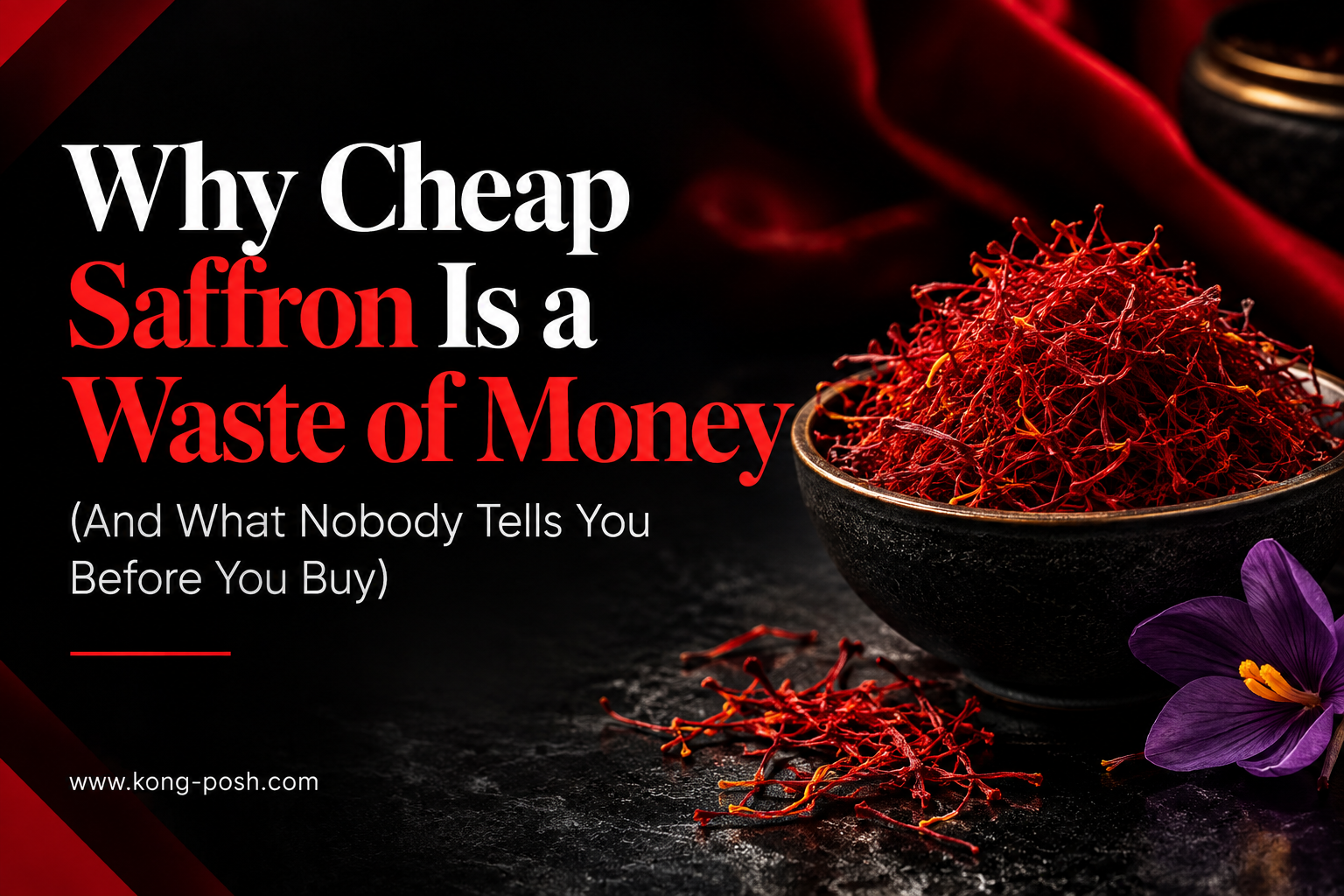
Most people don’t lose money on saffron because they overpay. They lose money because they underpay, and then have to buy it again, and again, chasing a result that cheap saffron was never going to give them in the first place.
If you have ever added a pinch of saffron to milk or rice and waited for that golden colour and warm aroma that never quite showed up, you are not doing anything wrong. The saffron is.
The uncomfortable truth about “affordable” saffron
Real saffron is the dried stigma of the Crocus sativus flower, and it takes close to 45,000 flowers, all hand-picked, to produce just one kilogram. That single fact should tell you something important: there is a real cost floor to genuine saffron, and anything priced well below it is not a deal. It is a compromise you don’t know you’re making yet.
A lot of what circulates online as “pure saffron” is actually corn silk, safflower petals (often sold as kesar in disguise), dyed grass fibres, or genuine saffron threads that have been soaked in glycerine or sugar syrup to add weight before they’re sold by the gram. None of this is theoretical. A 2025 peer-reviewed study in Critical Reviews in Food Science and Nutrition found that up to 60% of commercial saffron sold in India is adulterated, while globally around 20 to 30% of saffron on the market is tampered with or outright fake. That is not a small margin of error. That is a coin flip.
Why the price gap actually makes sense
Authentic Kashmiri saffron, especially the premium Mongra grade, currently trades at wholesale prices between roughly Rs 3,00,000 and Rs 5,00,000 per kilogram, and retail prices for genuine 10 gram packets have climbed to around Rs 3,250, pushing the per-kilo price to about Rs 3.25 lakh, up from Rs 2 lakh the previous year. It is now, quite literally, more valuable by weight than silver.
This isn’t marketing. It’s supply and demand doing exactly what it’s supposed to do. Kashmiri saffron only grows at an altitude of around 1,600 metres, in a narrow belt around Pampore, and it is harvested for a few short weeks each October and November, entirely by hand. There is no shortcut, no factory line, no way to mass-produce it without losing what makes it Kashmiri saffron in the first place.
At the same time, the actual supply of genuine saffron has been shrinking for years. Production in Kashmir fell by roughly 65% over 22 years, from 16 metric tonnes down to 5.6 metric tonnes, driven by climate change, cheaper Iranian imports, poor irrigation, and outdated post-harvest handling. Less real saffron in the market, combined with rising global demand, is exactly the environment where fakes flourish and prices for the genuine article keep climbing. If you’re waiting for saffron to get cheaper, you’re waiting for something that isn’t coming.
What the Geographical Indication tag actually changed
In July 2020, Kashmiri saffron was awarded a Geographical Indication (GI) tag, a certification meant to legally distinguish authentic Kashmir-grown saffron from imported or blended substitutes sold under the same name. Officials at the time noted that the tag was expected to stop adulteration of the spice and help it fetch a better price in export markets, since Kashmiri saffron grown at high altitude has a longer, thicker stigma, a deep natural red colour, and a distinctly strong aroma compared to other varieties.
The GI tag was a step forward, but a certificate on a government registry doesn’t stop a small vendor from relabelling cheap Iranian saffron as “Kashmiri” on an e-commerce listing. That part still comes down to who you’re buying from, and whether they can actually prove where their saffron came from.
How to tell if your saffron is real before you waste money again
You don’t need a lab to catch most fakes. A few checks at home will tell you most of what you need to know.
Drop a few threads into lukewarm water or milk. Real saffron releases its colour slowly, over several minutes, and the water turns a golden yellow while the threads themselves stay mostly red. Fake or dyed saffron bleeds colour almost immediately and often turns the water a deep red rather than gold, because the dye is designed to impress you fast rather than perform correctly.
Smell it. Genuine saffron has a distinct, slightly sweet, hay-like aroma with a metallic edge, not a flat, dusty smell or an artificial sweetness. Taste it. Real saffron has a bitter, warm, honey-like note, not a bland or chemical aftertaste.
And finally, do the arithmetic. If a seller is offering a gram of “pure Kashmiri saffron” for less than a few hundred rupees, ask yourself how that price is even mathematically possible given what a gram of the real thing actually costs to produce. It usually isn’t. It’s cut with something else, or it isn’t Kashmiri at all.
Why this matters more than a spice choice
Saffron isn’t only about colour and flavour. It has been used for generations in Kashmiri households for its warming properties, its role in postpartum care, its use in traditional wellness routines, and increasingly in modern skincare for its antioxidant properties. Adulterated saffron doesn’t just underperform in your kheer, it defeats the entire reason people reach for saffron in the first place. You end up paying for a placebo dressed up in a nice glass jar.
This is also why authenticity in saffron isn’t a small detail buried in the fine print. It is the entire product.
This is where Saffron Cottage comes in
We are growers, not traders. Saffron Cottage has been cultivating saffron in Kashmir for seven generations, long before GI tags and lab certifications existed, back when a family’s word and its harvest were the only guarantee a buyer needed. That tradition hasn’t changed, only the way we now prove it has.
Every batch we sell is harvested from our own fields in the saffron belt around Pampore, processed the traditional way, and never blended, bulked, or cut with anything else. When you buy from us, you are not buying from a listing that sources from unknown middlemen. You are buying directly from the family whose hands actually picked the flower.
With genuine Kashmiri saffron production shrinking every year and demand only rising, waiting to “buy later” usually means paying more for less, or getting talked into a cheaper alternative that isn’t real saffron at all. If you have been disappointed by saffron before, the problem was very likely never your recipe. It was your source.
Try real Kashmiri saffron once, from a family that has been growing it for seven generations, and you will understand immediately why the price difference was never the point. The result was.
Ready to taste the difference? Order authentic, GI-recognised Kashmiri saffron directly from Saffron Cottage and stop guessing whether what’s in your kitchen is actually saffron.
Frequently asked questions
Is cheap saffron ever real?
It’s possible but rare. Genuine saffron has a real production cost floor because of how labour-intensive harvesting is, so anything priced far below market rate is almost always adulterated, diluted, or mislabelled.
How can I test saffron at home?
Soak a few threads in lukewarm water or milk. Real saffron releases colour gradually and turns the liquid golden while the threads stay red. Fast, heavy colour bleeding usually signals dye.
Why is Kashmiri saffron more expensive than other saffron?
It grows only at high altitude in a small region of Kashmir, is harvested entirely by hand over a short season, and yields very little per flower, roughly 45,000 flowers per kilogram of saffron.
Where can I buy authentic Kashmiri saffron online?
Buy directly from established growers with a traceable harvest, rather than unnamed third-party sellers. Saffron Cottage sources and sells saffron grown on its own family farms in Kashmir.
Does the GI tag guarantee my saffron is genuine?
The GI tag protects the name “Kashmiri saffron” legally, but it doesn’t police every seller. Buying from a verified, direct-from-farm source is still the most reliable safeguard.