
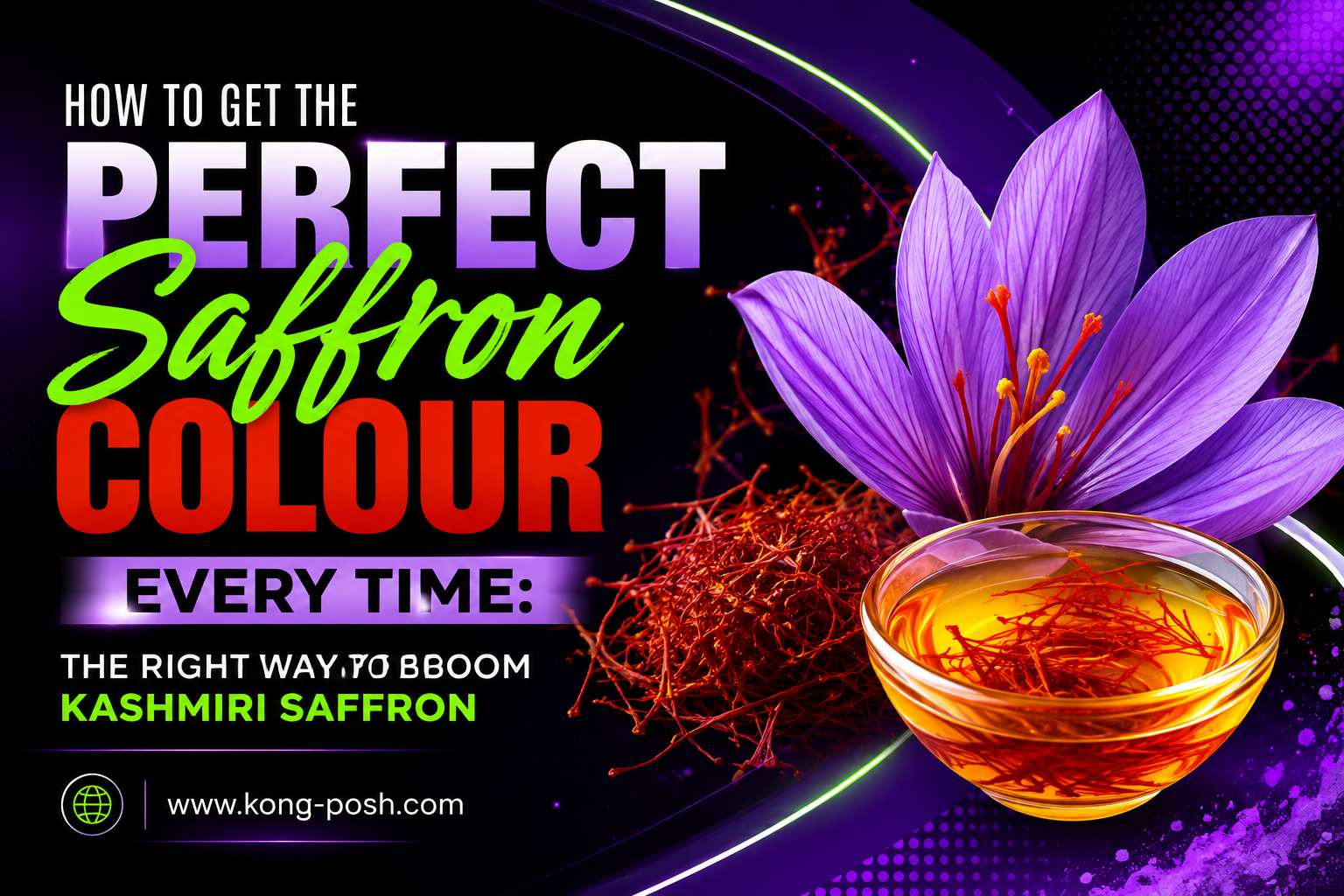
There is a moment when saffron goes from looking like a handful of delicate red threads to transforming an ordinary dish into something unforgettable.
You add a few saffron threads to warm liquid. You wait. Slowly, the liquid begins to change. Golden colour spreads through the water, followed by that distinctive aroma that tells you something special is happening.
But if your saffron water barely changes colour, turns an odd artificial-looking yellow immediately, or leaves your dish with more colour than flavour, the problem may not be your recipe.
It may be the saffron.
And this is exactly why knowing how to extract the colour from saffron properly matters.
For home cooks, bakers, chefs, restaurant owners and anyone who has invested in premium Kashmiri saffron, the goal is not simply to make food yellow. The goal is to release saffron’s natural colour, aroma and flavour while using every precious thread intelligently.
This guide explains exactly how to get the best saffron colour from saffron threads, how to bloom saffron correctly, what temperature to use, how long to steep it, which mistakes to avoid, and how to recognize quality saffron before it ever reaches your kitchen.
Most importantly, it will help you understand why premium saffron should be treated differently from an ordinary powdered spice.
Why does saffron turn food golden?
The beautiful golden-yellow colour associated with saffron comes primarily from natural compounds called crocins.
Crocin is one of the major compounds responsible for saffron’s colouring power. Picrocrocin contributes to its characteristic taste, while safranal is strongly associated with its aroma. These compounds are among the key characteristics considered when saffron quality is evaluated.
This explains something many first-time saffron users find surprising.
The saffron threads themselves are deep red or crimson, but when properly infused, they can release a rich golden-yellow colour into water, milk, broth or other cooking liquids.
That colour change is part of the magic.
But there is an important distinction.
A saffron thread that releases colour is not automatically proof of exceptional quality. Colour, aroma, taste, purity, moisture and other characteristics all matter when evaluating saffron.
That is why modern saffron quality discussions increasingly focus on measurable characteristics rather than simply asking whether the spice “looks red.”
What is the best way to get saffron colour?
The simplest and most reliable method is to bloom the saffron before adding it to your recipe.
Blooming means gently preparing saffron in a small quantity of warm liquid so that its colour, aroma and flavour can disperse before the saffron is incorporated into the dish.
For most home cooking, you can follow this simple process:
Take a small pinch of saffron threads.
Gently crush them between your fingers or with a mortar and pestle. You do not need to turn them into a fine powder. The goal is simply to increase the surface area and help the compounds disperse into the liquid.
Place the threads into a small amount of warm water, milk, stock or another suitable liquid depending on your recipe.
Allow the saffron to steep.
Then add both the infused liquid and the threads to your dish.
This small change can make a significant difference.
Instead of throwing dry saffron directly into a large pot and hoping for the best, you are giving the saffron a concentrated environment in which to release its character first.
How long should saffron be soaked for colour?
For everyday cooking, giving saffron time to bloom is more important than rushing it into the dish.
A practical starting point is around 10 to 20 minutes in warm liquid.
Some recipes use longer infusion times, particularly when saffron is being prepared in milk, cream or other ingredients. The exact time can depend on the recipe, quantity, temperature and desired intensity.
The important point is not to treat saffron like instant food colouring.
You are extracting a complex spice, not simply adding pigment.
If you have purchased genuinely high-quality saffron, patience is part of getting value from it.
One of the biggest mistakes people make is using expensive saffron but treating it like a cheap colouring powder.
Premium saffron deserves a slower approach.
Should you crush saffron before soaking it?
Yes, gentle crushing can be useful.
Whole threads are beautiful and allow you to see what you are buying, but lightly crushing them before blooming can help expose more surface area to the liquid.
There is no need to aggressively pulverize the saffron.
A mortar and pestle can be used, but even gently rubbing the threads between your fingers can help.
For delicate desserts such as saffron milk, firni, milk cake or kesar badam milk, a fine saffron infusion can distribute the colour more evenly.
For rice dishes such as saffron rice, pulao or biryani, you may prefer a mixture of infused saffron liquid and visible threads.
This gives the dish both colour and presentation.
What temperature should you use to bloom saffron?
This is where many people make a mistake.
You want warm liquid rather than aggressively boiling liquid.
Think gentle heat, not extreme heat.
Very high temperatures are unnecessary when preparing saffron for normal cooking. A gentle warm infusion gives the threads time to release their colour and aroma without treating the spice harshly.
For home cooks, the safest practical approach is simple: warm the liquid, add the saffron, and allow it to infuse rather than boiling the saffron aggressively from the beginning.
Remember that your objective is extraction, not destruction.
Can you put saffron directly into rice?
Yes, but blooming it first is often the better option when you want more consistent colour and flavour.
Imagine cooking a beautiful pot of basmati rice.
You add saffron threads directly into the cooking water.
Some threads may release colour effectively. Others may remain concentrated in particular areas. You may end up with uneven distribution.
Now compare that with preparing saffron separately in warm water or milk and gently pouring the infusion over the rice.
The difference can be dramatic.
You can distribute the golden colour more intentionally and control where the saffron goes.
This is particularly useful when preparing Persian-style rice, biryani, pulao, saffron rice and celebratory dishes where presentation matters.
Why is my saffron not turning the water yellow?
This question is more important than it sounds.
There are several possible reasons.
You may have used too little saffron.
The saffron may be old or poorly stored.
The liquid may not have been suitable for your recipe.
You may not have allowed enough time for infusion.
The threads may not have been properly prepared.
Or the saffron itself may be of questionable quality.
Saffron is one of the world’s most valuable spices, and its high value has historically made it vulnerable to adulteration. Research has documented the addition of other plant materials, dyes and lower-quality materials to saffron products.
That is why purchasing decisions matter almost as much as cooking technique.
You cannot cook your way out of poor-quality saffron.
Why red saffron threads should not instantly behave like food colouring
One of the easiest mistakes for a consumer is expecting premium saffron to behave like artificial food colouring.
Real saffron is not simply a red dye.
Its value comes from a combination of colouring power, aroma and taste.
ISO’s saffron standards specifically address characteristics including crocin, picrocrocin and safranal, along with other quality parameters. The current ISO 3632-1:2025 specification was published in July 2025 and applies to dried saffron in filament, cut-filament and powder forms.
That development is particularly relevant today because consumers are becoming more interested in measurable quality, provenance and authenticity.
The question is changing from:
“Is this saffron red?”
to:
“How pure is it, where did it come from, how was it handled, and what evidence supports its quality?”
That is a much smarter question.
How much saffron should you use?
Saffron is powerful.
You usually do not need a large quantity to make an impression.
The right amount depends on the recipe, number of servings and desired intensity.
For a small family dish, start with a modest pinch and adjust based on experience.
For desserts and beverages, you can increase the quantity according to the recipe.
For larger restaurant preparations, chefs should standardize the amount per serving rather than relying on guesswork.
This creates consistency.
And consistency is one of the biggest differences between cooking saffron casually at home and using saffron professionally.
If your restaurant sells saffron rice today, customers should experience a similar colour and aroma when they order it next week.
That requires a repeatable preparation method.
The five-minute saffron mistake
One of the biggest problems in modern cooking is impatience.
People spend money on premium ingredients and then rush the preparation.
Saffron is a perfect example.
They open the container.
Throw in a few threads.
Add boiling water.
Stir once.
Wait two minutes.
Then decide the saffron is not working.
Give it more time.
Saffron is a spice worth respecting.
Prepare it intentionally and you are more likely to get a balanced result.
The best liquids for blooming saffron
Water is the simplest choice.
Warm water is neutral and works exceptionally well for rice, savoury dishes and many desserts.
Milk is excellent for Indian and South Asian desserts and drinks.
Warm stock can work well in savoury dishes.
Cream can be useful in certain dessert and sauce applications.
The principle remains the same: use a liquid that complements the final dish.
If you are preparing saffron rice, warm water or stock may be ideal.
If you are preparing kesar milk, warm milk makes more sense.
If you are preparing a creamy dessert, saffron can be introduced into the dairy component.
The technique remains consistent even when the recipe changes.
How to get a deeper saffron colour without wasting saffron
This is where technique becomes more valuable than quantity.
Do not automatically add more saffron because the colour looks weak.
First ask yourself:
Did I bloom the saffron?
Did I crush it gently?
Was the liquid warm?
Did I give it enough time?
Was the saffron stored properly?
Did I buy whole threads or questionable powder?
Was the saffron fresh?
These questions can prevent unnecessary waste.
A premium ingredient should not be measured only by how much you use.
It should be measured by how much value you extract from every thread.
Why saffron storage affects your cooking results
Even excellent saffron can lose quality if it is stored carelessly.
Keep saffron in an airtight container away from moisture, direct sunlight and excessive heat.
Avoid repeatedly opening the container unnecessarily.
Do not leave saffron exposed near a hot stove.
Do not store it beside strongly scented spices if the container is not properly sealed.
Saffron is delicate.
Treat it like a premium ingredient rather than an ordinary spice sitting forgotten at the back of a cupboard.
This is particularly important for people who buy saffron in larger quantities.
Buying premium saffron is only half the job.
Protecting it after purchase is the other half.
Whole saffron threads or saffron powder: which is better?
For consumers who care about transparency, whole saffron threads are often easier to inspect visually than powder.
Powdered saffron can be convenient, but visual inspection becomes more difficult because other materials can be blended into powders.
The International Organization for Standardization has specifically noted that fraud is more common in powdered saffron because lower-cost spices can be added to increase mass.
That does not mean every saffron powder is fake.
It means consumers should understand the additional difficulty of visually assessing powdered saffron.
Whole threads give you more information before you even begin cooking.
You can examine their colour, shape and overall appearance.
For a premium saffron brand, transparency starts before the kitchen.
How to recognize better-quality saffron
Do not rely on one trick.
There is no single home test that can replace proper quality assessment.
Modern saffron quality evaluation looks at multiple characteristics, including colouring power, taste-related compounds, aroma-related compounds, moisture and purity. ISO 3632 provides an international framework for evaluating saffron quality.
That is why claims such as “premium,” “pure” or “Grade A” should ideally be supported by meaningful information about the product.
Consumers today are becoming smarter.
They want to know the origin.
They want to know the product form.
They want to know how it is handled.
They want to know who is behind the brand.
And increasingly, they want traceability.
That is good for genuine growers and honest saffron businesses.
Why origin matters when buying Kashmiri saffron
Saffron is not just a spice.
For many families, growers and communities, it represents agricultural knowledge passed through generations.
At Saffron Cottage, our story is deeply connected to that tradition.
We are the growers of FINEST KASHMIRI SAFFRON, harvesting from 7th generations.
That statement is more than a marketing line.
It represents the importance of understanding where your saffron comes from and respecting the people and agricultural practices behind it.
When customers buy saffron, they are not simply buying colour for rice.
They are buying an ingredient whose value begins long before it reaches the kitchen.
The flower must be cultivated.
The delicate stigmas must be harvested.
The saffron must be processed and dried properly.
It must be stored carefully.
And eventually, it must reach the customer in a condition worthy of the ingredient.
That journey matters.
The new saffron consumer is asking better questions
The saffron market is moving toward a more informed consumer.
People are increasingly searching for:
“How can I tell if saffron is real?”
“How do I use Kashmiri saffron?”
“How long should I soak saffron?”
“Why is my saffron not turning yellow?”
“How much saffron should I use in rice?”
“What is the best way to bloom saffron?”
“How do I store saffron?”
“How can I identify high-quality saffron?”
“What does ISO 3632 mean for saffron?”
These are not random questions.
They show a major shift in consumer behaviour.
People do not just want a product.
They want knowledge before they buy.
And brands that educate rather than simply advertise are positioned to earn greater trust.
Saffron Cottage: from the grower to your kitchen
This is where Saffron Cottage has an opportunity to tell a different story.
Our focus is not simply on selling another spice.
It is about bringing the experience of fine Kashmiri saffron closer to people who genuinely appreciate quality.
We are the growers of FINEST KASHMIRI SAFFRON harvesting from 7th generations.
That heritage gives us a reason to care about what happens after the customer receives the saffron.
We want you to know how to use it.
We want you to understand why blooming matters.
We want you to know how to protect it.
And most importantly, we want you to experience why good saffron can transform a simple recipe.
A few threads in warm milk.
A delicate golden layer over rice.
A fragrant biryani.
A luxurious dessert.
A traditional Kashmiri preparation.
The quantity may be small.
The difference can be unforgettable.
A simple saffron blooming method you can save
If you want a practical method to use every time, remember this sequence:
Start with quality saffron threads.
Take a small pinch.
Gently crush or rub the threads.
Place them in a small amount of warm liquid.
Allow them to bloom for around 10 to 20 minutes.
Watch the colour develop naturally.
Add both the saffron infusion and threads to your recipe.
Adjust the quantity based on the recipe and number of servings.
Do not boil the saffron aggressively.
Do not judge quality only by colour.
Do not waste extra saffron simply because you rushed the infusion.
This simple process can become your standard saffron routine.
The golden rule of saffron cooking
Here is the most important lesson:
Do not chase colour alone.
Chase balance.
A beautiful saffron dish should have colour, aroma and flavour working together.
If your dish is intensely yellow but has no characteristic saffron aroma, something is missing.
If the aroma is overwhelming but the dish tastes harsh, you may have used too much.
If the saffron barely contributes anything, investigate the ingredient and preparation method.
Great cooking is not about making an ingredient louder.
It is about making it work.
Saffron mistakes that can cost you more
Using poor-quality saffron is expensive.
Using too much saffron because you do not know how to bloom it is expensive.
Storing saffron incorrectly is expensive.
Buying powder without understanding its provenance can be risky.
Adding saffron directly to a large volume of liquid without blooming can lead to inconsistent results.
Leaving saffron beside heat and moisture can reduce its quality over time.
And perhaps the biggest mistake is buying based entirely on price.
The cheapest saffron is not necessarily the best value.
The most expensive saffron is not automatically the best either.
The smarter approach is to look at quality, provenance, transparency, handling and the reputation of the seller.
A practical guide for different dishes
For saffron rice, bloom the saffron in warm water or stock and distribute the infusion near the end of cooking.
For biryani, use saffron-infused milk or water as a finishing layer to create aroma and golden highlights.
For kesar badam milk, gently infuse saffron in warm milk before combining it with the other ingredients.
For desserts such as phirni or milk cake, allow the saffron to bloom before adding it to the dairy mixture.
For sauces, broths and savoury dishes, use a small amount of warm cooking liquid to extract the saffron before incorporating it.
For baking, saffron can be infused into warm milk or another liquid component of the recipe.
The common thread is simple.
Give saffron time to release itself.
Who should buy premium Kashmiri saffron?
Premium Kashmiri saffron is particularly relevant for people who care about authentic ingredients rather than simply adding colour to food.
Our audience includes home cooks who want better results, families preparing traditional recipes, food enthusiasts exploring Kashmiri cuisine, bakers creating premium desserts, chefs and restaurants seeking distinctive ingredients, gift buyers looking for something meaningful, and consumers who are willing to pay for provenance and quality.
It is also relevant to people who have previously purchased saffron but were disappointed because they did not get the expected colour, aroma or flavour.
If you fall into any of these groups, the next step is not necessarily to buy more saffron.
First, learn how to use the saffron you already have.
Then learn how to identify quality.
Then choose your supplier carefully.
That is how you turn an expensive spice into a worthwhile culinary experience.
Why the future of saffron is about trust
The future of premium food products is increasingly connected to transparency.
Consumers have more information than ever.
They can compare brands.
They can read reviews.
They can search for origin information.
They can investigate quality standards.
They can ask AI assistants questions before purchasing.
They can discover recipes through social platforms and search engines.
That means a brand cannot depend only on attractive packaging.
The product has to deliver.
The story has to make sense.
The claims have to be responsible.
And the customer needs to feel that the brand understands the ingredient.
Saffron Cottage has an opportunity to build its identity around exactly that connection: heritage, cultivation, quality, education and the experience of using genuine Kashmiri saffron.
Before you buy your next saffron, stop and ask these questions
Where is the saffron from?
Are you buying whole threads or powder?
Can the seller explain its origin?
How is it stored?
What information does the seller provide about quality?
Does the brand educate customers about using saffron?
Does the product have a clear identity and provenance?
Are you buying because the price looks attractive or because you understand the value?
These questions can save you from disappointment.
More importantly, they change the way you think about saffron.
You stop seeing it as an expensive red spice.
You start seeing it as a delicate agricultural product that deserves careful handling.
Your next cup of saffron milk can be better
The next time you open your saffron jar, do not rush.
Take a few threads.
Look at them.
Gently crush them.
Place them in warm milk.
Wait.
Watch the colour slowly spread.
Smell the infusion.
Then taste it.
That small ritual changes the way you cook with saffron.
And once you understand it, you may never throw dry saffron straight into a recipe again.
The final secret to perfect saffron colour
Perfect saffron colour does not begin with the cooking pot.
It begins with the saffron itself.
Then comes preparation.
Then patience.
Then technique.
Then the recipe.
If you start with poor-quality saffron, no cooking trick can completely transform it.
If you start with quality saffron but use it incorrectly, you may waste much of its potential.
But when quality and technique meet, something beautiful happens.
A simple dish becomes golden.
The aroma becomes noticeable.
The flavour becomes deeper.
And suddenly you understand why saffron has remained one of the world’s most treasured culinary ingredients.
At Saffron Cottage, we believe the story should not end when the saffron reaches your kitchen.
We are the growers of FINEST KASHMIRI SAFFRON harvesting from 7th generations.
Now it is your turn to make every thread count.
Choose your saffron carefully. Store it properly. Bloom it patiently. Cook with intention.
And the next time someone asks you how to get the perfect saffron colour, you will know the answer:
Do not simply add saffron.
Prepare it properly.
Let it bloom.
Let quality speak.
Call to action
Ready to experience the difference that properly prepared Kashmiri saffron can make?
Explore Saffron Cottage and discover fine Kashmiri saffron grown with generations of knowledge behind it.
Do not wait until your next special occasion to discover what genuine saffron can do.
Bring a few precious threads into your kitchen, bloom them properly, and turn an ordinary recipe into something worth remembering.
Your best saffron dish may be only one carefully prepared infusion away.
Frequently asked questions
How do I get the most colour from saffron?
Gently crush the saffron threads and bloom them in a small amount of warm liquid for around 10 to 20 minutes before adding the infusion to your recipe. This helps distribute the saffron’s natural colour more effectively.
Why is my saffron not turning yellow?
Possible reasons include low-quality saffron, insufficient quantity, poor storage, inadequate blooming time or incorrect preparation. Do not judge saffron quality from colour alone.
Should I soak saffron in hot or cold water?
Warm liquid is generally a practical choice for blooming saffron. Avoid aggressively boiling the saffron during the initial infusion.
Can I use milk to bloom saffron?
Yes. Warm milk is particularly suitable for saffron-based drinks and dairy desserts.
How long should I soak saffron?
Around 10 to 20 minutes is a useful starting point for everyday cooking, although some recipes may call for longer infusion periods.
Is Kashmiri saffron better than other saffron?
Origin alone does not guarantee quality. Saffron should be evaluated through characteristics such as purity, colouring power, aroma, taste, handling and provenance. International standards such as ISO 3632 provide a framework for saffron quality evaluation.
What gives saffron its colour?
Crocin-related compounds are major contributors to saffron’s characteristic colouring power, while picrocrocin and safranal are associated with taste and aroma respectively.
Is saffron powder better than saffron threads?
Powder can be convenient, but whole threads are easier for consumers to visually inspect. Because powdered saffron can be more difficult to authenticate visually, purchasing from a transparent and reputable supplier is particularly important.