
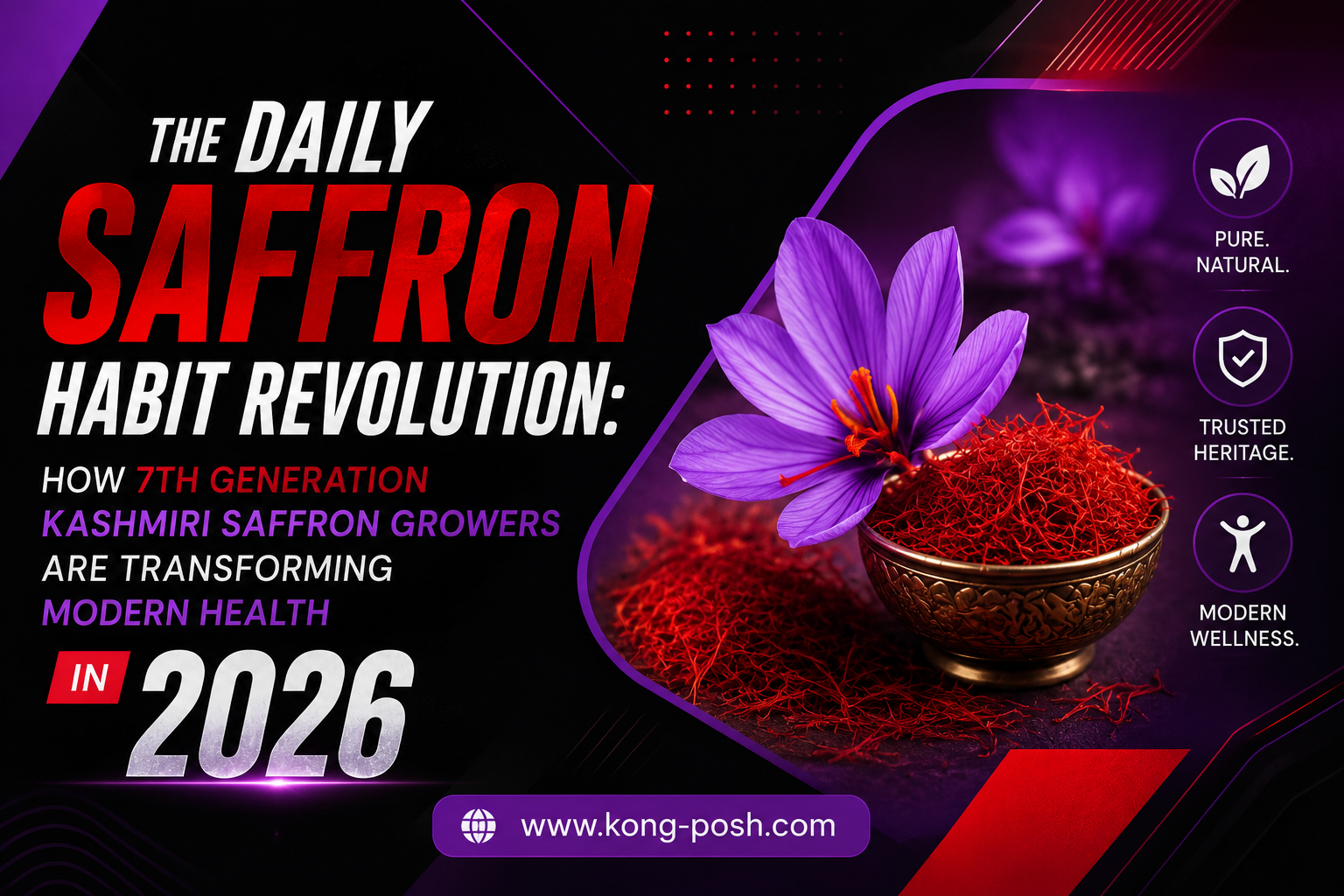
Why are more people making saffron part of their daily routine in 2026?
There is a noticeable change happening in the way people think about wellness.
People are no longer looking only for complicated diets, expensive wellness products, or extreme routines. Increasingly, they are looking at simple, traditional ingredients that have been part of human food culture for generations and asking a modern question: how can I make better everyday choices without making my life more complicated?
One ingredient continues to attract attention: saffron.
Known for its distinctive aroma, golden colour and delicate flavour, Kashmiri saffron has moved far beyond its traditional role as a premium kitchen spice. In 2026, consumers are becoming more interested in food ingredients that combine heritage, authenticity, culinary value and emerging scientific research.
But there is an important distinction.
Not all saffron deserves the same level of trust.
When an ingredient becomes popular, the market inevitably becomes crowded with different qualities, origins, claims and prices. That makes authenticity more important than ever.
This is where Saffron Cottage brings a different story.
We are the growers of FINEST KASHMIRI SAFFRON, harvesting from 7th generations.
And that heritage is not simply a marketing sentence. It represents a relationship with saffron cultivation that has been passed through generations, where understanding the crop, its character and its traditional use matters.
The real saffron revolution in 2026 is not about consuming more.
It is about choosing better.
What is Kashmiri saffron and why does its origin matter?
Saffron comes from the flower Crocus sativus. The valuable saffron threads are the dried stigmas of the flower, which are carefully harvested and processed.
Because harvesting is labour-intensive and the usable portion of each flower is extremely small, genuine saffron is naturally a premium spice.
Kashmir is particularly associated with saffron cultivation, especially the Pampore region, where saffron farming has a long cultural and agricultural history.
For consumers, origin matters because saffron is not simply a commodity where colour alone determines quality.
The source, cultivation practices, harvesting, drying, storage and handling can all influence the final product.
That is why asking “Where does this saffron come from?” should be just as important as asking “How much does it cost?”
A suspiciously low price should not automatically be interpreted as a bargain.
Sometimes, cheap saffron can become an expensive mistake.
The modern saffron consumer is asking better questions
The wellness consumer of 2026 is more informed than ever.
Before purchasing a premium food ingredient, people increasingly want to know:
Where was it grown?
Is it authentic?
How was it harvested?
How should it be stored?
How much should I use?
What does scientific research actually say?
Can I use it in everyday food?
Is the product traceable?
Does the brand have a genuine relationship with the source?
These questions matter because the internet has created an enormous amount of information about saffron, but not all of that information is reliable.
You will find claims suggesting that saffron can solve almost every health problem imaginable.
That is where consumers need to slow down.
Saffron should be appreciated as a premium food ingredient with promising areas of scientific research, not treated as a miracle cure.
The smartest approach is simple: respect the tradition, understand the evidence and avoid exaggerated promises.
What are the potential benefits of saffron according to modern research?
Saffron contains naturally occurring compounds including crocin, crocetin, picrocrocin and safranal.
Researchers have investigated saffron and its compounds in several areas, including mood, oxidative stress, inflammation, cognition and other aspects of human health.
Some clinical research has produced interesting findings, particularly around mood-related outcomes, while other areas remain under investigation.
This distinction is important.
“Research is promising” does not mean “saffron is proven to treat every condition.”
Consumers should be especially cautious when a seller promises that saffron will cure diseases, replace medication, guarantee weight loss or produce dramatic medical outcomes.
Saffron is best understood as part of a balanced lifestyle rather than a shortcut around one.
That makes it even more interesting.
Because a small culinary ritual can be meaningful without making unrealistic promises.
The daily saffron habit: small ritual, premium ingredient
Imagine starting your morning differently.
Instead of adding another complicated step to your routine, you prepare warm milk or water and allow a few genuine saffron threads to infuse.
The colour slowly changes.
The aroma appears.
The flavour becomes subtle but distinctive.
It takes only a few minutes.
This is the type of habit that fits modern life because it does not demand perfection.
You can add saffron to milk, rice, desserts, tea-style beverages, traditional recipes and festive dishes.
The goal is not to consume enormous quantities.
The goal is to appreciate a small amount of a high-value ingredient.
That is what makes saffron particularly fascinating.
It is a reminder that wellness does not always need to look complicated.
How to use saffron in your everyday routine
There are several simple ways to incorporate saffron into food.
Saffron milk
Add a small number of saffron threads to warm milk and allow them to infuse before drinking.
For additional flavour, some people pair saffron with cardamom, almonds or other traditional ingredients.
Saffron water
Saffron threads can be infused in warm water and consumed as a simple beverage.
However, more is not necessarily better. Saffron is intensely aromatic and should be used sparingly.
Saffron rice
A few saffron threads can transform ordinary rice into an aromatic dish with a beautiful golden appearance.
This is one of the easiest ways to appreciate saffron without making it the centre of a complicated recipe.
Saffron desserts
From traditional milk-based desserts to modern cakes, puddings and homemade treats, saffron can add a sophisticated flavour profile.
Saffron during celebrations
Saffron has traditionally been associated with hospitality, celebrations and special occasions across South Asian culinary culture.
Using it in festive recipes is therefore more than a flavour decision. It connects food with heritage.
How can you tell if saffron is genuine?
This is one of the most important questions consumers should ask before buying.
Authentic saffron deserves careful attention because adulteration and misidentification can occur in spice markets.
There are several things consumers can examine, although no simple home test can replace proper laboratory authentication.
Genuine saffron threads generally have a distinctive appearance, aroma and flavour. Threads should not simply look like uniformly bright red or artificially coloured material.
Another warning sign is an unbelievable price.
Premium saffron requires significant labour and production effort. If a seller is offering a quantity at a price that seems impossible compared with the wider premium saffron market, investigate before purchasing.
Look at the brand.
Look at its origin story.
Look for transparent product information.
Ask questions.
A trustworthy seller should not be uncomfortable explaining where its saffron comes from.
Why the 7th generation story matters
In a world where brands can be created overnight, generational agricultural knowledge has a different value.
Saffron Cottage represents a heritage built around seven generations of saffron growing.
We are the growers of FINEST KASHMIRI SAFFRON harvesting from 7th generations.
That statement reflects something modern consumers increasingly value: provenance.
People want to know the story behind what they purchase.
Who grew it?
Where did it come from?
What traditions surround it?
How did it reach my kitchen?
For Saffron Cottage, the answer begins with Kashmir and generations of knowledge connected to saffron cultivation.
That heritage gives the product a story that cannot be manufactured through packaging alone.
The biggest saffron mistake people make in 2026
The biggest mistake is believing that the lowest price automatically represents the best value.
It does not.
When buying premium saffron, price should be evaluated alongside authenticity, origin, quality, handling, trust and transparency.
Another mistake is buying saffron solely because an advertisement claims extraordinary health benefits.
A responsible consumer should separate three things:
Traditional use.
Scientific research.
Medical claims.
They are not the same.
Saffron has a rich traditional history and an expanding research base, but that does not give sellers permission to promise medical outcomes that have not been established.
The future of saffron marketing should be more honest, not more exaggerated.
And consumers should demand that standard.
Why saffron is becoming part of the modern wellness conversation
The wellness industry is shifting toward rituals.
People want routines they can actually maintain.
That is why traditional foods, spices, teas and natural ingredients continue to attract attention.
Saffron fits this trend naturally.
It is small.
It is concentrated.
It has culinary heritage.
It has a distinctive sensory experience.
And it has attracted scientific interest.
But perhaps its strongest appeal is psychological.
A daily saffron ritual encourages people to slow down.
Instead of rushing through another meal or beverage, you take a moment to prepare something intentionally.
In an increasingly digital world, small physical rituals can feel surprisingly valuable.
The future of wellness may not always be about adding more.
Sometimes it is about making ordinary moments more intentional.
Saffron, technology and the new era of informed buying
Technology is also changing how people purchase food.
Consumers can now compare brands, investigate origins, read reviews, research ingredients and ask AI-powered tools questions before making a purchase.
This means brands cannot depend on beautiful packaging alone.
They need information.
They need transparency.
They need consistency.
They need a real story.
They need to answer the questions consumers are already asking.
For saffron brands, this creates an important opportunity.
The strongest brands of the future will not simply say “premium saffron.”
They will explain why.
They will educate customers about origin, harvesting, storage, usage and authenticity.
They will acknowledge what science does and does not prove.
They will make it easier for consumers to make informed decisions.
That is the direction Saffron Cottage believes in.
Who should consider buying Kashmiri saffron?
Saffron Cottage can appeal to several types of consumers.
Home cooks who want to improve the flavour and presentation of everyday meals can use saffron in rice, milk and desserts.
Food enthusiasts can explore saffron as one of the world’s most distinctive culinary spices.
Premium ingredient buyers may appreciate its heritage, rarity and craftsmanship.
Gift buyers can choose saffron for people who appreciate traditional foods and luxury ingredients.
Wellness-focused consumers may be interested in incorporating saffron into balanced food routines while keeping expectations realistic and evidence-based.
Restaurants, cafés, chefs and hospitality businesses may also find authentic Kashmiri saffron valuable when developing premium dishes and signature recipes.
The common factor is not a particular age group.
It is an appreciation for quality.
What should you look for before buying saffron online?
Before clicking “buy,” take a minute.
Ask yourself five questions.
Where is the saffron from?
Does the seller clearly explain its origin?
Does the brand provide meaningful information about quality and handling?
Does the product presentation appear consistent with genuine saffron threads?
Is the seller making realistic claims rather than promising miracles?
If you cannot get clear answers, think twice.
A premium ingredient deserves a premium level of transparency.
This is especially important when buying online because consumers cannot physically inspect the product before purchasing.
The brand’s information becomes part of the buying experience.
Why buying directly from a grower can change the experience
There is a growing consumer movement toward knowing where food comes from.
People are asking more questions about farmers, supply chains, production and provenance.
The farm-to-consumer idea has therefore become increasingly powerful.
When you buy saffron from a grower-led brand, the story becomes more direct.
With Saffron Cottage, that story is rooted in seven generations of Kashmiri saffron cultivation.
That connection matters because saffron is not an ordinary mass-produced spice.
It is harvested from delicate flowers, requires significant labour and has a long cultural history.
When you understand that journey, you understand why genuine saffron deserves to be treated differently.
A practical 7-day saffron habit to start today
If you have never used saffron regularly, do not overcomplicate it.
Start small.
On the first day, learn about the saffron you purchased and its origin.
On the second day, try a simple saffron milk infusion.
On the third day, use a few threads in rice.
On the fourth day, experiment with a traditional dessert.
On the fifth day, try saffron-infused water if it suits your routine.
On the sixth day, explore a new recipe.
On the seventh day, decide which preparation you genuinely enjoy.
The objective is not to force yourself into a wellness routine.
It is to discover a simple culinary ritual that fits naturally into your lifestyle.
The urgency is not to buy more saffron. It is to buy smarter.
There is a bigger lesson behind the saffron trend.
As consumers become increasingly interested in natural ingredients, premium spices and traditional wellness practices, demand for saffron will continue to attract attention.
That creates opportunities for genuine producers.
But it also creates opportunities for poor-quality products, misleading claims and confusing marketing.
Consumers therefore have a responsibility.
Do not buy simply because something says “Kashmiri.”
Do not believe every health claim.
Do not assume expensive automatically means authentic.
Do not assume cheap automatically means value.
Ask questions.
Research the source.
Understand what you are purchasing.
And choose brands that are willing to educate you rather than simply sell to you.
Why Saffron Cottage is part of this new saffron movement
Saffron Cottage is built around a simple belief: authentic saffron should have a story worth telling.
We are the growers of FINEST KASHMIRI SAFFRON harvesting from 7th generations.
That means our connection with saffron begins with cultivation and heritage rather than simply placing a label on a packet.
Our goal is to bring genuine Kashmiri saffron closer to people who appreciate quality, tradition and authenticity.
We want consumers to understand what they are buying.
We want saffron to be enjoyed in everyday kitchens, not treated as something that only belongs in expensive restaurants or special occasions.
And we want the conversation around saffron to become more informed.
Because when people understand the value of an ingredient, they make better choices.
Your next saffron ritual starts with one decision
You do not need a complicated wellness routine.
You do not need dozens of products.
You do not need to chase every trend on the internet.
Start with something simple.
Choose an authentic ingredient.
Learn where it came from.
Use it thoughtfully.
Enjoy it.
And make quality part of your everyday choices.
The saffron revolution of 2026 is not about turning saffron into a miracle product.
It is about rediscovering the value of a remarkable ingredient while combining generations of agricultural heritage with modern consumer awareness.
At Saffron Cottage, that journey begins in Kashmir.
Seven generations of saffron-growing heritage.
One premium ingredient.
And a tradition that deserves to be experienced, not just advertised.
If you have been searching for genuine Kashmiri saffron, now is the time to look beyond price and packaging. Discover the story behind the threads, understand the source and choose saffron that comes with heritage.
Explore Saffron Cottage and bring the tradition of finest Kashmiri saffron into your everyday kitchen.
Frequently asked questions about Kashmiri saffron
What is Kashmiri saffron?
Kashmiri saffron is saffron associated with the Kashmir region of India. It is valued for its distinctive aroma, flavour, colour and long-standing cultivation heritage.
Is Kashmiri saffron good for everyday use?
Saffron can be incorporated into everyday foods in small culinary quantities. It can be used in milk, rice, desserts and other recipes.
How much saffron should I use?
Saffron is highly concentrated, so culinary recipes generally require only a small amount. Follow the preparation instructions for your specific recipe and avoid assuming that larger quantities provide greater benefits.
What makes saffron expensive?
Saffron is labour-intensive to produce. The valuable stigmas must be harvested from individual flowers, making production relatively demanding compared with many other spices.
Can saffron support health and wellness?
Research has investigated saffron and its naturally occurring compounds in several areas of health, including mood and oxidative stress. However, saffron should not be presented as a replacement for medical treatment or a guaranteed cure for health conditions.
How can I identify genuine saffron?
Look for clearly identified origin, reputable sourcing, appropriate product information and a transparent seller. Home tests can provide clues but cannot definitively authenticate saffron in the same way professional testing can.
Why choose Saffron Cottage?
Saffron Cottage is built around seven generations of Kashmiri saffron-growing heritage. The brand focuses on bringing finest Kashmiri saffron to consumers while highlighting provenance, tradition and quality.
Final thought
The next big wellness trend may not be something invented in a laboratory.
It may be something that has been quietly growing in Kashmir for generations.
Saffron reminds us that the future does not always mean leaving tradition behind.
Sometimes, the future means returning to something valuable, understanding it better and bringing it into modern life with greater awareness.
The question is no longer simply, “Do you use saffron?”
The better question is:
“Do you know where your saffron comes from?”
That is where the real revolution begins.